
A water or ground source heat pump should not be selected by building area alone.
A reliable system must match the building load, source-water or ground-loop conditions, required outlet-water temperature, circulation flow, hydraulic resistance, domestic hot water demand, electrical supply, and control strategy.
Even when the heat pump itself is correctly selected, a project can still suffer from insufficient heating, excessive electricity use, unstable operation, or frequent alarms if the groundwater flow is inadequate, the ground loop is undersized, the circulation pumps consume too much power, or the terminal units require higher water temperatures than expected.
This guide is intended for project owners, HVAC contractors, distributors, consultants, and procurement teams. It explains the information required before requesting quotations and provides a practical framework for comparing different system proposals.
What Matters Most When Buying a Water or Ground Source Heat Pump System?
Before comparing equipment prices, buyers should answer nine questions.
| Procurement priority | Question to answer | Information the supplier should provide |
|---|---|---|
| Source feasibility | Can the site provide a reliable water source or accommodate a ground loop? | Well test, geological information, thermal response data, or source-side design conditions |
| Capacity at project conditions | How much heating or cooling capacity remains at the actual source and load temperatures? | Capacity, input power, and efficiency at the specified operating condition |
| Total system efficiency | Does the published COP include circulation pumps? How much power will the well pump use? | Unit performance table, pump selection, and annual energy estimate |
| Multiple operating modes | How will space heating, cooling, and domestic hot water be prioritized? | Operating-mode matrix, DHW tank design, and control sequence |
| Ground-loop or well size | How many boreholes, how much pipe, or how much water flow will be required? | Load calculation, borefield simulation, or well-system design |
| Terminal compatibility | Can the unit operate with underfloor heating, fan coils, radiators, or air handling units? | Required supply and return water temperatures and flow rates |
| Hidden project costs | Does the quotation include pumps, heat exchangers, tanks, valves, and commissioning? | A clear supply scope and exclusion list |
| Maintenance requirements | How will water quality, filtration, scaling, and remote monitoring be managed? | Water-quality limits, maintenance instructions, and control specifications |
| Responsibility for performance | Who designs and verifies the heat source, heat pump, hydraulics, and controls? | Responsibility matrix, commissioning procedure, and acceptance criteria |
A low equipment price has limited value if the source system, pumps, controls, or commissioning requirements are excluded.
Water Source vs. Ground Source Heat Pump Systems
The U.S. Department of Energy describes a geothermal heat pump system as having an underground heat collector, a heat pump, and a building distribution system. The underground heat exchanger may be installed vertically or horizontally.
The DOE also notes that, in many areas of the United States, temperatures at a depth of about 30 feet, or 9 metres, remain relatively stable at approximately 10–15°C. Local ground temperature and geological data must still be used for actual design. U.S. Department of Energy: Geothermal Heat Pumps
Commercial systems generally use one of the following source configurations.
Closed-Loop Ground Source System
A closed-loop system circulates water or an antifreeze solution through pipes buried in the ground. The circulating fluid does not directly mix with groundwater.
Common arrangements include:
- Vertical boreholes
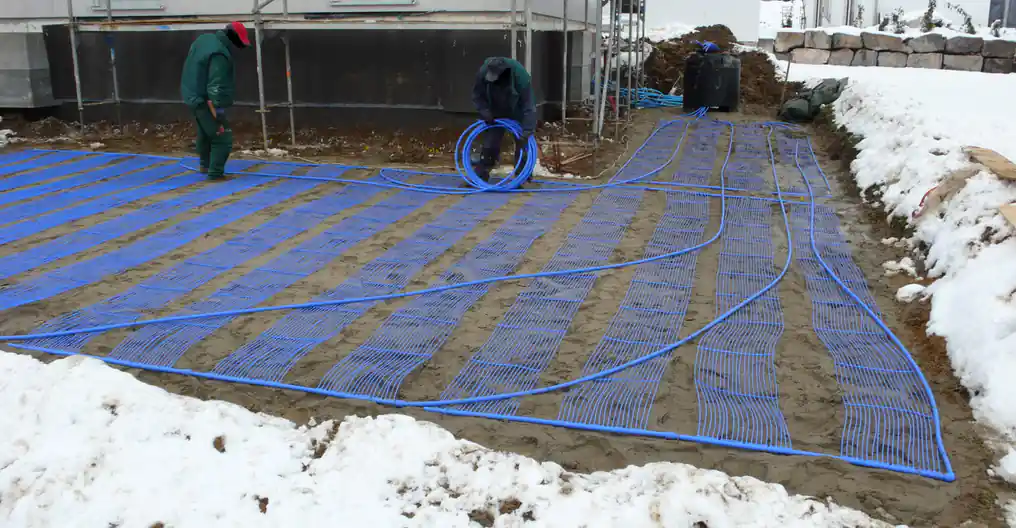
- Horizontal trenches
- Horizontal spiral or slinky loops
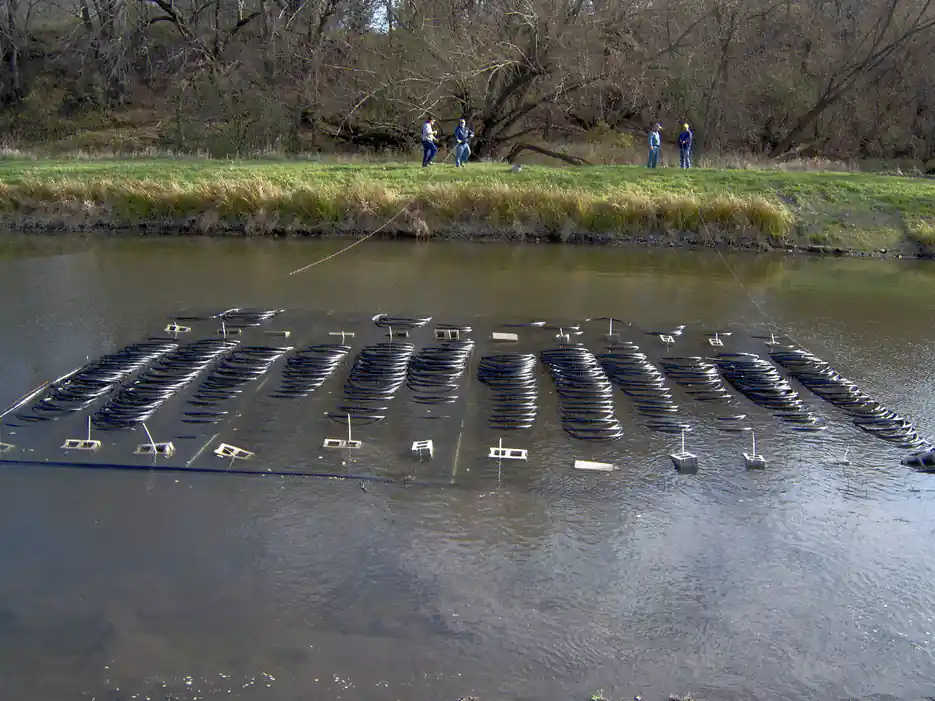
- Closed coils installed in a suitable lake or pond
Vertical systems require less land, but drilling costs can be high. Horizontal systems may cost less to install where sufficient land is available, but their performance is more affected by soil moisture, burial depth, rainfall, and seasonal ground-temperature changes.
Open-Loop Groundwater System
An open-loop system pumps groundwater from a production well, passes it through an isolation heat exchanger or heat pump, and then discharges or reinjects it.
This arrangement may reduce the amount of buried pipe required, but the project must confirm:
- Sustainable well flow
- Static and pumping water levels
- Seasonal groundwater availability
- Groundwater temperature
- Sand and suspended solids
- Hardness, chloride, iron, manganese, and pH
- Pumping head
- Discharge or reinjection method
- Reinjection-well capacity
- Water abstraction and discharge permits
ASHRAE points out that groundwater heat pump systems may require fouling protection when the water quality is poor. Pumping energy can also become excessive when the aquifer is deep or the water system is poorly designed. ASHRAE Handbook, Chapter 35
Legal requirements vary by location. In the United States, for example, wells used to return heat pump water underground may fall under the EPA’s Class V Underground Injection Control program. Other countries and regions may require separate drilling, water abstraction, discharge, reinjection, or environmental permits. U.S. EPA: Class V Injection Wells
Engineered Water Loop or Surface-Water System
Some projects can use a building water loop, lake, pond, river, mine water, wastewater source, or another engineered water circuit.
The presence of water does not automatically make it a suitable heat source.
The project still needs to verify:
- Minimum and maximum source temperatures
- Available flow throughout the year
- Water chemistry
- Sediment and biological fouling
- Filtration requirements
- Heat-exchanger material
- Intake and discharge arrangements
- Environmental approvals
- Freeze protection
Step 1: Calculate the Real Building Load
Do Not Select the Heat Pump by Floor Area Alone
A watts-per-square-metre estimate can support an early budget, but it is not sufficient for final equipment selection.
The design team should calculate or confirm:
- Winter design heating load
- Summer sensible cooling load
- Summer latent cooling load
- Monthly or hourly load profile
- Domestic hot water demand
- Building operating schedule
- Ventilation volume
- Indoor design temperature and humidity
- Insulation and window performance
- Occupant, lighting, and equipment gains
- Whether heating and cooling can occur at the same time
A hotel, apartment building, school, office, and villa can have completely different load patterns even when their floor areas are similar.
Calculate Domestic Hot Water Separately
Domestic hot water should not simply be added to the space-heating load.
The DHW calculation should include:
- Daily hot water consumption
- Peak consumption period
- Incoming cold-water temperature
- Storage temperature
- Required storage volume
- Recirculation losses
- Required tank recovery time
- Hygiene or thermal disinfection requirements
- Auxiliary electric heating strategy
If the system gives DHW priority, the designer should also determine how long space heating can be interrupted while the storage tank is being reheated.
Step 2: Confirm the Source Before Selecting the Heat Pump
What Is Required for a Vertical Ground Loop?
A vertical borefield design normally requires:
- Undisturbed ground temperature
- Ground thermal conductivity
- Ground thermal diffusivity
- Borehole thermal resistance
- Borehole depth and diameter
- Borehole spacing
- Grout type
- Groundwater movement
- Annual ground heat extraction and rejection
- Minimum and maximum permitted entering-fluid temperatures
- Pipe and header pressure losses
For larger systems, uncertain geological conditions, or projects with high drilling costs, the design team should evaluate whether a thermal response test is justified.
A thermal response test can help determine the site’s effective ground conductivity and borehole resistance. This reduces the risk of installing an unnecessarily large borefield or an undersized field that cannot maintain acceptable loop temperatures.
What Is Required for a Horizontal Ground Loop?
Horizontal-loop design should consider:
- Available land
- Burial depth
- Soil type
- Soil moisture
- Drainage conditions
- Buildings, roads, and underground services
- Future land use
- Pipe spacing and thermal interference
- Seasonal ground-temperature variation
Dry soil and wet soil can have very different heat-transfer performance. A fixed pipe length per kilowatt should therefore be treated as a budget estimate, not as a final design rule.
Why “Metres of Borehole per Kilowatt” Is Not a Final Design Method
Ground-loop length is affected by both peak load and long-term energy balance.
If a cooling-dominated building rejects much more heat into the ground than it extracts each year, the ground temperature may rise over time. A strongly heating-dominated project may gradually reduce the ground temperature.
ASHRAE explains that ground heat exchanger design should consider loads over different time scales, including peak loads and annual ground-load imbalance. ASHRAE Ground Source Heat Pump Design Guidance
Ground-loop length should therefore be calculated from project-specific data rather than copied from another installation.
Step 3: Compare Heat Pumps at the Project Operating Condition
COP Must Always Be Read Together With Its Rating Condition
Heat pump COP is not a fixed value. It changes with source-side entering temperature and load-side leaving temperature.
Common rating conditions include:
- B0/W35: 0°C brine on the source side and 35°C water on the load side
- W10/W35: 10°C source water and 35°C load-side water
- W10/W55: 10°C source water and 55°C load-side water
In heating mode, a lower source temperature and a higher outlet-water temperature generally increase the required temperature lift. This can reduce both heating capacity and COP.
For a commercial quotation, ask the supplier to provide:
- Heating capacity at the minimum design source temperature
- Cooling capacity at the maximum design source temperature
- Input power at the required outlet-water temperature
- COP or cooling efficiency at the same condition
- Required source-side flow
- Required load-side flow
- Pressure drop through both heat exchangers
- Maximum input current
- Part-load performance
- Operating limits
ISO 13256-2 covers the testing and rating of water-to-water and brine-to-water heat pumps. AHRI’s geothermal and water-source heat pump certification program also verifies ratings such as heating capacity, cooling capacity, COP, and EER for products within its program scope. AHRI Geothermal and Water-Source Heat Pump Program
This does not mean that every heat pump carries AHRI certification. The buyer should verify the rating standard and certification status of the specific product being offered.
What Does “Up to 60°C Outlet Water” Mean?
A maximum outlet-water temperature describes an operating limit. It does not prove that the unit will retain its nominal capacity or published COP at 60°C.
For a high-temperature radiator or DHW application, request the following data at the required high-water-temperature condition:
- Available heating capacity
- Input power
- COP
- Permitted source-water temperature
- Compressor operating limits
- Auxiliary heating requirements
A unit capable of reaching 60°C may still be more efficient when operating at 35–45°C.
Step 4: Calculate Source-Side and Load-Side Flow
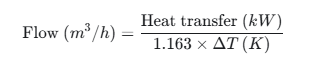
For a clean-water circuit, preliminary flow can be calculated as:
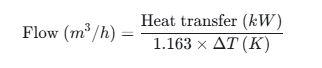
If glycol or another antifreeze fluid is used, the calculation must be corrected using the actual density and specific heat at the selected concentration and operating temperature.
Heating Flow Calculation Example
Assume that a project requires 24 kW of heating and the heat pump has a COP of 4.0 at the project condition.
The approximate compressor input is:
24÷6=6kW
The source must provide approximately:
24-6=18kW
If the source-side temperature difference is 3 K, the preliminary clean-water flow is:
18÷(1.163×3)=5.16m³/h
If the load-side temperature difference is 5 K, the preliminary load-side flow is:
24÷(1.163×5)=4.13m³/h
This example shows why source flow should not automatically be calculated from the delivered heating capacity. Part of the delivered heat comes from the compressor’s electrical input.
Final pump selection must also consider:
- Heat pump pressure drop
- Ground-loop or well-system resistance
- Main and branch pipe losses
- Valves, strainers, filters, and heat exchangers
- Actual well pumping head
- Reinjection pressure
- Antifreeze viscosity
- Minimum heat pump flow
- Pump operating efficiency
The same principle applies in cooling mode, except that the source system must reject both the building cooling load and the compressor heat.
Step 5: Match the Heat Pump to the Terminal Water Temperature
The terminal-water temperature directly affects heat pump performance.
Underfloor Heating
Underfloor heating normally uses relatively low water temperatures and is well suited to heat pump operation.
The design should still verify:
- Building heat loss
- Floor construction
- Pipe spacing
- Floor-covering resistance
- Maximum permitted floor-surface temperature
- Required flow in each circuit
Fan Coils and Air Handling Units
Coil capacity must be checked at the actual supply and return water temperatures.
A coil selected for a conventional boiler or chiller may not provide the required capacity when connected to a lower-temperature heat pump system. A larger coil surface, higher airflow, or different water flow may be required.
Radiators
Existing radiators may have been selected for boiler water temperatures of 70°C or higher. Before replacing the boiler with a heat pump, calculate the radiator output at the proposed 45°C, 50°C, or 55°C supply temperature.
Possible improvements include:
- Increasing radiator surface area
- Installing low-temperature radiators
- Adding fan coils
- Improving the building envelope
- Using electric backup for short peak-load periods
Chilled-Water Terminals
Cooling design should confirm:
- Supply and return water temperatures
- Sensible and latent cooling loads
- Indoor dew point
- Condensate drainage
- Fan-coil dehumidification capacity
- Condensation protection for radiant cooling
- Minimum water temperature
Step 6: Design the Complete Hydraulic System
The heat pump is only one component of the complete installation.
Depending on the project, the hydraulic system may also require:
- Source-side circulation pump or well pump
- Load-side circulation pump
- Isolation heat exchanger
- Buffer tank
- Domestic hot water tank
- Expansion vessel
- Air separator
- Dirt separator
- Y-strainer or automatic filter
- Balancing valves
- Check valves
- Flow switch
- Temperature and pressure sensors
- Fill and pressure-relief equipment
- Antifreeze filling and testing equipment
Does the System Need a Buffer Tank?
A buffer tank should be evaluated when:
- The system water volume is low
- Zone valves frequently reduce the active load
- Several heat pumps operate in stages
- The heat pump requires a minimum running time
- DHW priority changes the load-side flow
- The heat pump needs constant flow while the terminals use variable flow
- The minimum building load is below the heat pump’s minimum capacity
Buffer-tank volume should be calculated from minimum run time, minimum system load, permitted water-temperature change, and existing system volume.
How Does Antifreeze Affect the System?
Antifreeze provides freeze protection, but it also reduces heat capacity and increases fluid viscosity and pumping resistance.
Confirm:
- Antifreeze type
- Design concentration
- Freeze-protection temperature
- Compatibility with pipes, seals, and heat exchangers
- Local environmental restrictions
- Corrected flow and pressure loss
- Circulation-pump correction factor
IGSHPA currently identifies CSA/ANSI/IGSHPA C448:2025 as its current design and installation standard. Its previous 2017 standard has been sunset for current design work. IGSHPA Standards
Every project must also comply with the codes and environmental requirements of the installation location.
Step 7: Include Pumping Energy in the Efficiency Calculation
Comparing heat pump COP alone can overestimate the efficiency of the complete system.
Total electrical consumption may include:
- Compressor
- Internal heat pump pumps
- Ground-loop circulation pump
- Groundwater well pump
- Load-side circulation pump
- Fan coils or air handling units
- DHW recirculation pump
- Controls
- Auxiliary electric heating
For annual comparison, use a system seasonal performance factor:
A groundwater source may offer a favourable temperature, but a deep well with high pumping head can reduce or eliminate that advantage.
The supplier should therefore state whether the published COP includes any internal pumps and identify all external pump power separately.
Step 8: Decide the Number of Heat Pumps and the Backup Strategy
A single large unit may have a lower initial equipment cost. Multiple units in parallel can offer:
- Better part-load matching
- Staged capacity control
- Partial operation during maintenance
- Lower cycling risk
- Easier future expansion
Depending on the importance of the building, the project may use:
- One unit for the full load
- Multiple staged units
- An N+1 redundancy arrangement
- Heat pumps for the base load with electric backup for short peak periods
The electric heater capacity, activation conditions, and electrical demand must be included in both the design and the operating-cost calculation.
Step 9: Define the Heating, Cooling, and DHW Control Sequence
A heat pump that supports heating, cooling, and domestic hot water does not necessarily provide full rated capacity to all three loads at the same time.
Before procurement, confirm:
- Whether heating and cooling operate seasonally
- Whether simultaneous heating and cooling are required
- Whether DHW has priority
- Whether space heating stops during DHW production
- Required DHW tank recovery time
- Motorized valve arrangement
- Pump interlocks
- Minimum source-temperature protection
- Freeze protection
- Remote alarms
- Restart behaviour after a power failure
- Auxiliary heating activation
- Energy-metering requirements
If the building requires simultaneous heating, cooling, and hot water, ask for a hydraulic schematic and operating-mode matrix. Do not rely on a general “three functions” statement.
Step 10: Compare Total Installed Cost and Lifecycle Cost
A complete project budget may include:
- Heat pump units
- Geological investigation or well testing
- Thermal response testing
- Borehole drilling and grouting
- Production and reinjection wells
- Ground-loop or source-side pipework
- Circulation pumps and well pumps
- Isolation heat exchangers
- Buffer and DHW tanks
- Valves, strainers, and expansion equipment
- Electrical distribution
- Control system
- Plant-room installation
- Commissioning and training
- Permits and inspections
Use the same building load, operating hours, and energy prices when comparing proposals.
The lifecycle comparison should include:
- Heat pump cost
- Borefield or well-system cost
- Annual compressor electricity
- Annual pumping electricity
- Auxiliary heating consumption
- Filtration and water-treatment costs
- Cleaning and inspection costs
- Expected major equipment replacement
Payback depends on climate, load profile, energy prices, drilling costs, and local incentives. A payback period from another project should not be applied without recalculation.
Ground Source and Water Source System Comparison
| Item | Vertical ground loop | Horizontal ground loop | Open-loop groundwater |
|---|---|---|---|
| Land requirement | Relatively low | High | Relatively low |
| Site investigation | Geology and thermal properties | Soil, moisture, and available land | Well yield, groundwater level, and water quality |
| Main source investment | Drilling and grouting | Excavation and pipe installation | Production well, reinjection or discharge, and well pumps |
| Main operating risk | Insufficient loop length or long-term thermal imbalance | Seasonal ground and moisture variation | Falling water level, scaling, blockage, or poor reinjection |
| Pumping energy | Depends on loop and header resistance | Depends on pipe length and circuit design | Strongly affected by well depth and reinjection pressure |
| Water-quality exposure | Low | Low | High |
| Typical permit issues | Drilling and underground construction | Excavation and land-use rules | Water abstraction, discharge, and reinjection |
| Suitable applications | Limited land and long-term operation | Low-rise sites with available land | Sites with a verified and legally usable water source |
No source type is suitable for every project. The final decision should be based on site conditions, system risk, and lifecycle cost.
What Should Be Checked During Commissioning?
Ground-Loop System
The handover package should include:
- Borehole drilling records
- Actual borehole locations and depths
- Pipe and grout records
- Pressure-test results
- Flushing and purging records
- Antifreeze type and concentration
- Circuit balancing results
- Total ground-loop flow
- Ground-loop pressure drop
- As-built drawings
Groundwater System
The handover package should include:
- Sustained well-flow test
- Static and pumping water levels
- Water temperature
- Water-quality report
- Sand content
- Reinjection test
- Well-pump flow, head, and power
- Filter and isolation heat-exchanger pressure drop
- Water abstraction and discharge approvals
Heat Pump System
Commissioning measurements should include:
- Source entering and leaving water temperatures
- Load entering and leaving water temperatures
- Actual flow on both circuits
- Compressor input power
- Circulation-pump input power
- Heating operation
- Cooling operation
- DHW changeover
- High- and low-temperature protection
- Low-flow protection
- Remote control and communication
- Alarm history
- Control-parameter backup
A record showing that the heat pump can start is not sufficient evidence that the system achieves its design performance.
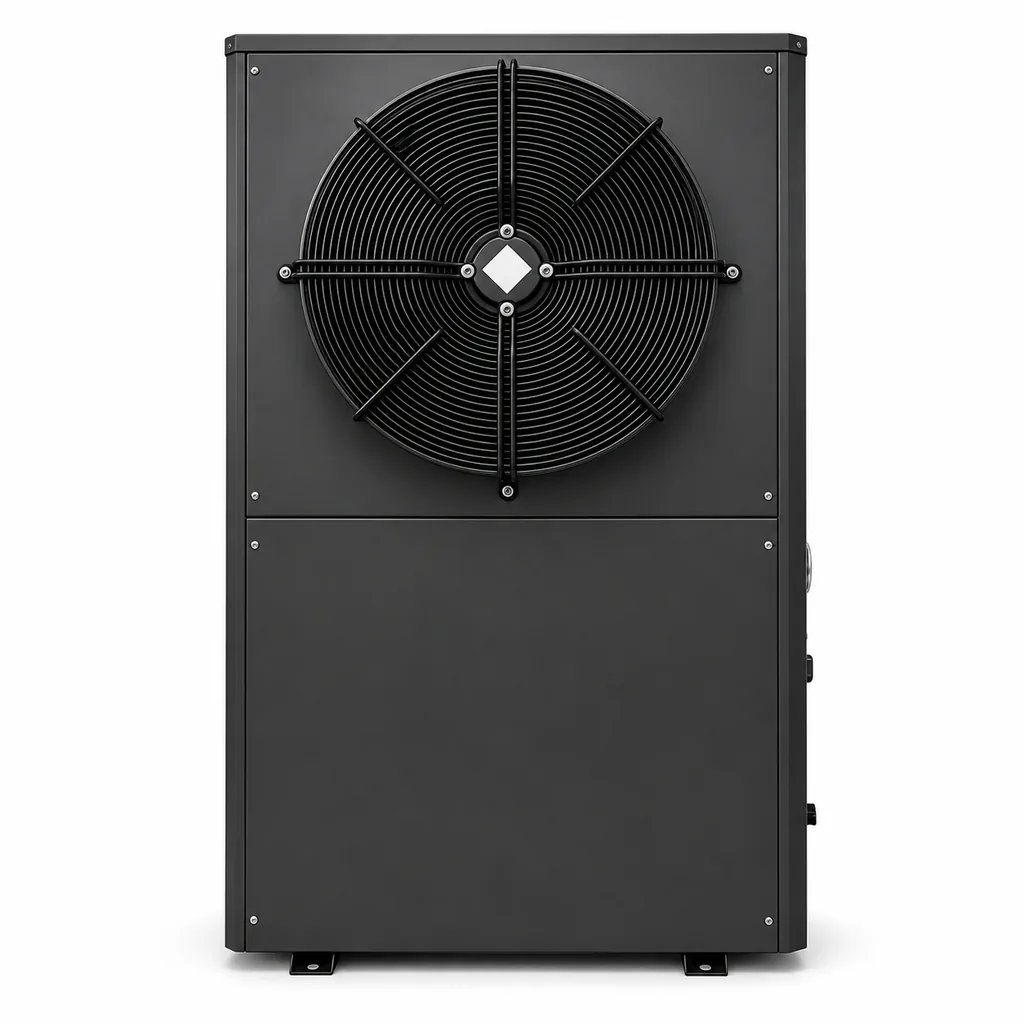
CASSKY All-in-One Water and Ground Source Heat Pump
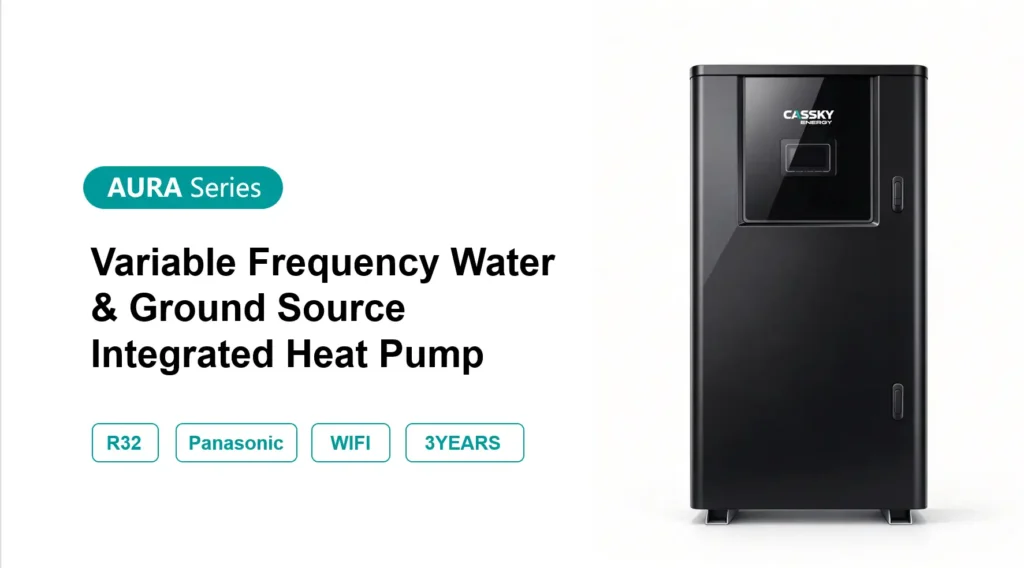
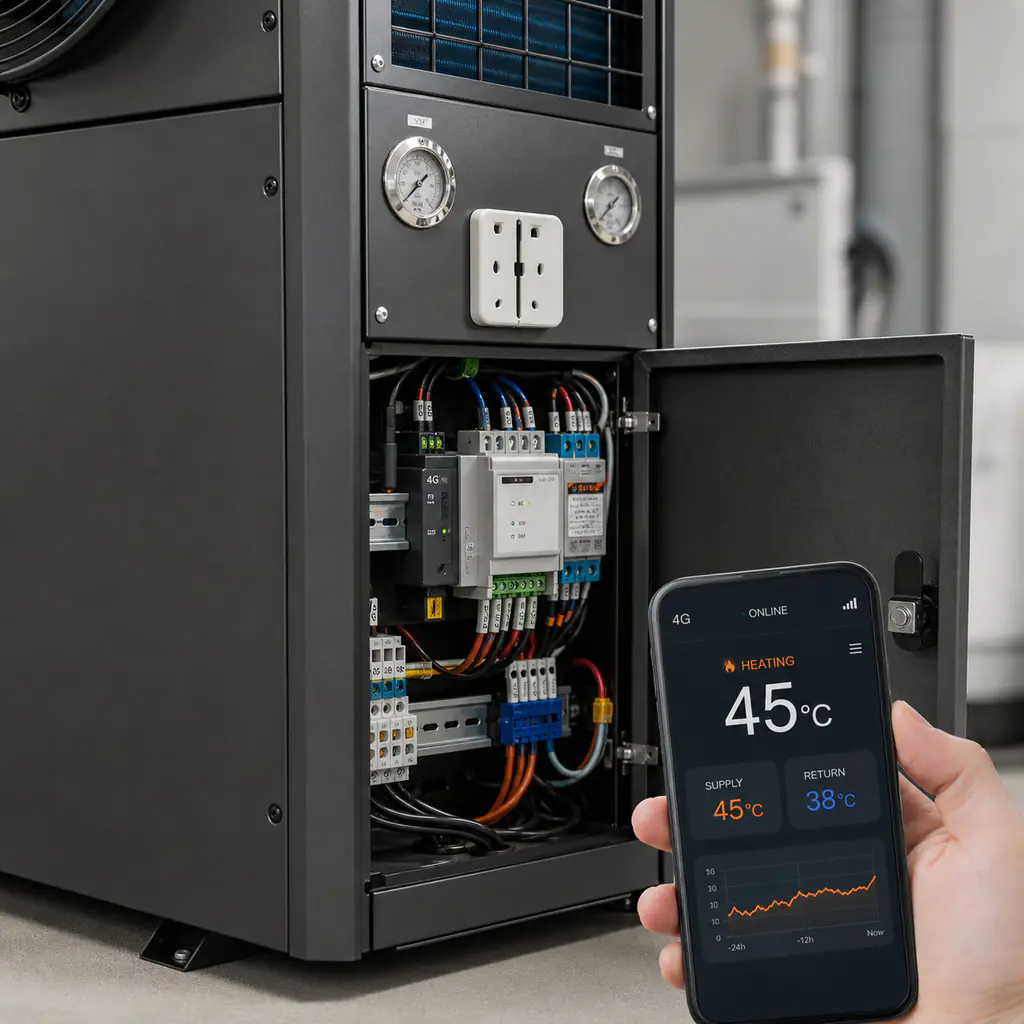
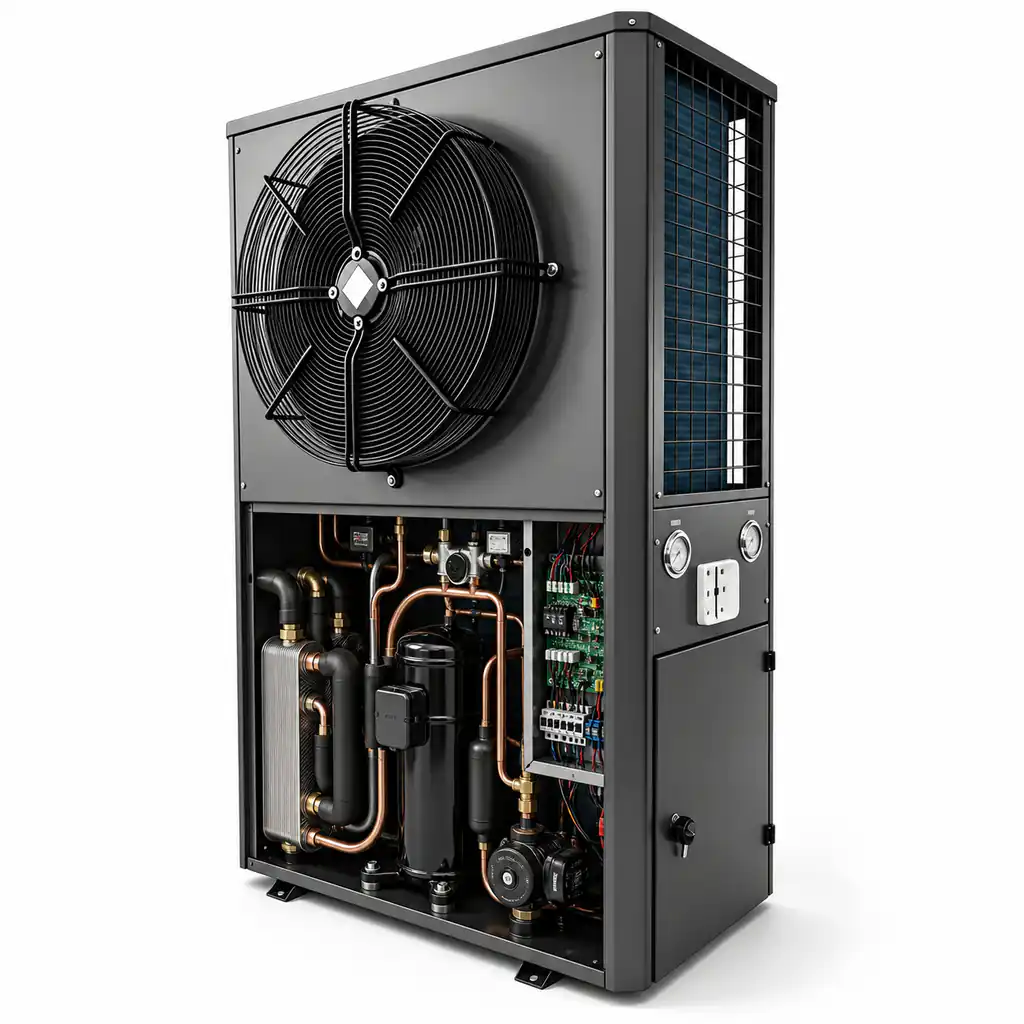
The CASSKY All-in-One Water / Ground Source Heat Pump is an indoor water-to-water heat pump platform designed for connection to a qualified water source or an engineered closed ground loop.
Depending on the selected model and hydraulic design, the system can support:
- Space heating
- Space cooling
- Domestic hot water
- Ground-loop or qualified water-loop operation
- Indoor equipment installation
- Remote status monitoring and control
- Building-management-system communication
The series is intended for villas, apartments, and light commercial buildings.
Current Series Selection Data
| Parameter | Current reference value |
|---|---|
| Heating capacity | 6–30 kW |
| Cooling capacity | 5–26 kW |
| Maximum heating outlet water | Up to 60°C |
| Minimum cooling outlet water | Down to 7°C |
| Reference heating COP | Up to 4.8 at B0/W35 |
| Reference cooling EER | Up to 5.2 at W30/W7 |
| Source side | Ground loop or qualified water loop |
| Power supply | 220–240 V single phase or 380–415 V three phase, depending on model |
| Control communication | RS485 / Modbus RTU options can be discussed |
| Remote functions | Supported configurations can provide 4G monitoring and control |
These values are intended for preliminary product screening. Capacity, efficiency, water-temperature limits, electrical supply, communication, and internal hydraulic components vary by model and rating condition.
Before procurement, request the model-specific datasheet, performance table, hydraulic diagram, controller manual, and confirmed supply scope.
Why Project Data Matters
A 20 kW heating requirement does not automatically mean that a nominal 20 kW heat pump is suitable.
CASSKY selection should be based on the capacity available at the project’s actual:
- Source entering temperature
- Required heating outlet temperature
- Required cooling outlet temperature
- Source and load flow
- Water quality
- Electrical supply
- DHW demand
- Operating mode
This prevents a nominal rating at one favourable condition from being used for a more demanding application without correction.
Information Required for CASSKY Project Selection
For a preliminary model recommendation, provide:
- Project country and city
- Building type
- Conditioned floor area
- Winter design heating load
- Summer design cooling load
- Domestic hot water demand
- Proposed source type
- Minimum and maximum source entering temperature
- Available source flow
- Groundwater analysis, if applicable
- Heating supply and return water temperatures
- Cooling supply and return water temperatures
- Estimated pipe pressure loss
- Electrical supply
- Required quantity
- Modbus or remote monitoring requirements
- OEM, packaging, and document requirements
Based on this information, CASSKY can review the candidate model, unit quantity, operating condition, and additional information required for system design.
RFQ Checklist for Comparing Suppliers
Send the same project information to every supplier so that quotations can be compared on the same basis.
Project Information
- Installation location:
- Building application:
- Design heating load:
- Design cooling load:
- DHW load:
- Source type:
- Source entering temperature range:
- Heating supply and return temperatures:
- Cooling supply and return temperatures:
- Electrical supply:
- Required quantity:
Require Each Supplier to State
- Recommended model and quantity
- Heating capacity at the project condition
- Cooling capacity at the project condition
- Input power at the project condition
- COP and cooling efficiency
- Required source-side flow
- Required load-side flow
- Pressure drop on both sides
- Maximum input power and current
- Noise rating and test condition
- Dimensions and operating weight
- Water connection sizes
- Included pumps, valves, and hydraulic components
- Control and communication interfaces
- Heating, cooling, and DHW operating modes
- Protection functions
- Included supply scope
- Exclusions
- Commissioning requirements
- Warranty conditions
- Applied performance-rating standard
This format prevents suppliers from quoting different rating conditions or leaving major system components outside the stated price.
Frequently Asked Questions
Can the Same Heat Pump Be Used for Water Source and Ground Source Projects?
Some water-to-water heat pumps can operate with either a qualified water source or a closed ground loop. The selected model must cover the project’s actual entering-water temperature, flow, and fluid type. Changing the source may also change capacity, efficiency, pump selection, and protection settings.
Does Every Ground Source Heat Pump Project Require Borehole Drilling?
No. A horizontal ground loop can be used where sufficient land is available. A closed-loop pond or lake system may also be possible where the water body, environmental conditions, and local regulations are suitable. Vertical boreholes are commonly used when land is limited.
Can a Heat Pump Be Selected by Building Area?
Building area can support an early estimate, but final selection requires heating load, cooling load, DHW demand, terminal-water temperature, source temperature, and operating schedule.
How Much Ground Loop Is Required?
There is no universal loop length per kilowatt. The required length depends on ground conductivity, borehole resistance, peak load, annual energy balance, borehole spacing, and permitted loop temperature.
Can Groundwater Flow Directly Through the Heat Pump?
It may be technically possible when water quality meets the heat exchanger requirements. Many commercial projects use an isolation heat exchanger between the groundwater and the closed heat pump circuit to reduce scaling, corrosion, and maintenance risk.
Can a Ground Source Heat Pump Produce Domestic Hot Water?
Yes, when the selected model and hydraulic design support DHW production. The design must include the required water temperature, storage volume, recovery time, hygiene requirements, mode priority, and auxiliary heating strategy.
Does 60°C Outlet Water Make the Heat Pump Suitable for Every Radiator System?
No. The buyer must check heating capacity, COP, source-temperature limits, and radiator output at the proposed operating temperature. Reaching 60°C does not mean the unit retains its nominal capacity or efficiency at that condition.
Does a Higher COP Always Mean Lower System Electricity Consumption?
No. Published COP normally describes the heat pump at a defined test boundary. Total system consumption also includes well pumps, ground-loop pumps, load pumps, terminal fans, controls, and auxiliary heaters.
Can the Ground Loop Provide Free Cooling?
Free or passive cooling may be possible when the source temperature is low enough and the terminal system is suitable. The design must also manage indoor humidity, condensation, heat exchanger approach temperature, pumping energy, and long-term ground heat balance.
Should the Ground Loop Be Sized for the Peak Load?
Peak capacity is only one design factor. The borefield also needs to account for monthly loads, annual heat extraction and rejection, long-term ground-temperature change, and the permitted entering-water temperature range.
References
- U.S. Department of Energy — Geothermal Heat Pumps
- ASHRAE Handbook — Chapter 35: Ground-Source Heat Pumps and Geothermal Energy
- International Ground Source Heat Pump Association — Standards
- AHRI — Geothermal and Water-Source Heat Pump Certification Program
- U.S. Environmental Protection Agency — Class V Injection Wells
- CASSKY — All-in-One Water / Ground Source Heat Pump
This guide supports preliminary system selection and procurement. Final ground-loop, groundwater, hydraulic, electrical, and control design should be completed or reviewed by qualified professionals according to local regulations.