
A commercial ground source heat pump should not be selected from building area or nominal unit capacity alone. The equipment, ground heat exchanger, building terminals, pumps and control sequence must operate as one system across peak and part-load conditions.
For a broader explanation of water-source and ground-source configurations, procurement responsibilities and commissioning requirements, read the Water and Ground Source Heat Pump System Design Guide.
This article has a narrower purpose. It explains which ground-loop and building inputs are needed to compare commercial solutions and determine when vertical boreholes, horizontal collectors, surface-water loops, open-loop groundwater or hybrid systems are appropriate. It does not replace geological design, borefield simulation, local permitting or the complete procurement process covered by the pillar guide.
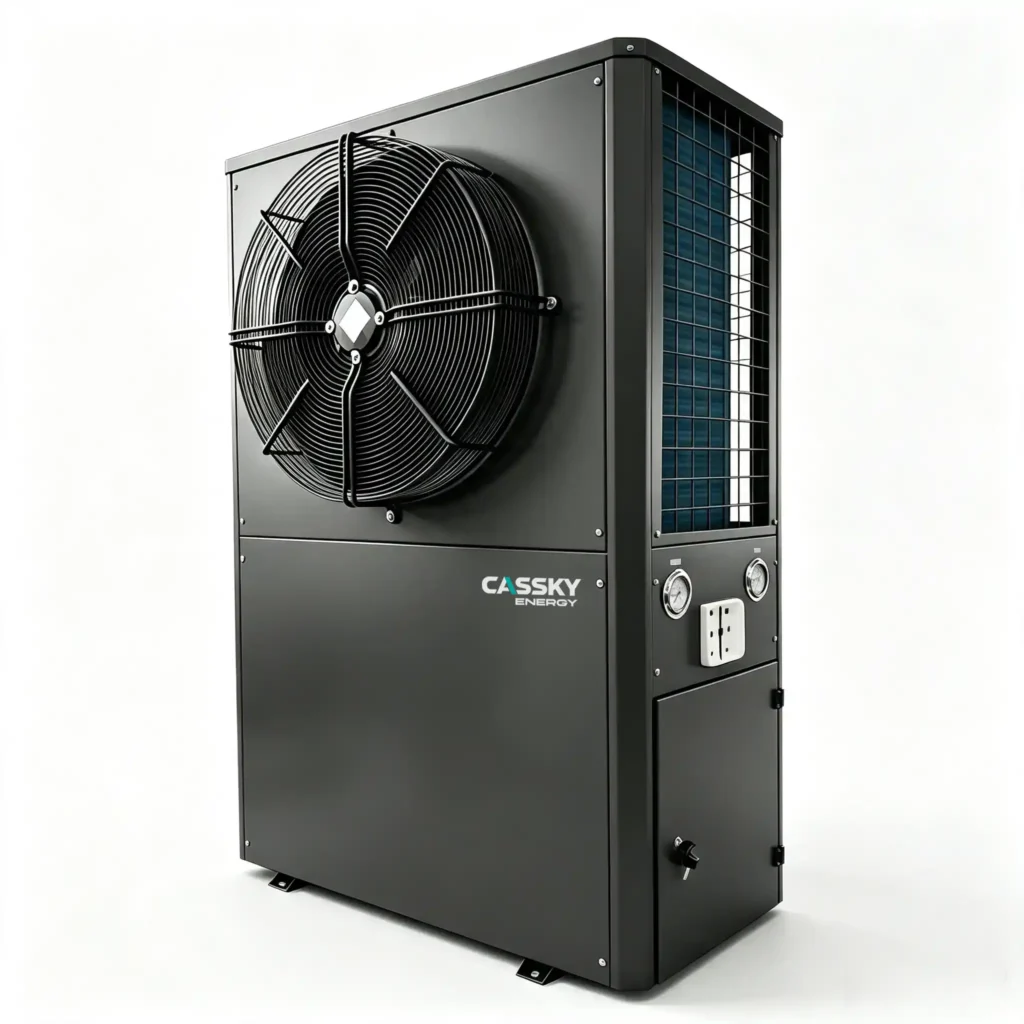
What Commercial Buyers Need to Decide First
Before comparing heat pump quotations, the buyer should resolve four questions:
- Can the site provide a technically and legally usable heat source or heat sink?
- What are the building’s simultaneous peak loads, hourly load profile and annual heat balance?
- What water temperatures must the heat pump deliver to the building?
- Which party is responsible for the ground loop, equipment, hydraulics, controls and whole-system performance?
These questions are connected. For example, a unit may meet the building’s nominal heating load at 35°C outlet water but fail to provide the required capacity or COP at 55°C. Likewise, a borefield may handle the winter peak yet experience long-term temperature drift if the building rejects substantially more heat than it extracts each year.
Therefore, a valid commercial proposal must connect the equipment selection to both the building model and the ground-side design.
Ground Source System Comparison
The best source configuration depends on land availability, geology, groundwater conditions, annual load balance and project risk. No arrangement is automatically preferable for every commercial building.
| Source configuration | Conditions where it is usually more appropriate | Principal design inputs | Conditions that may make it unsuitable |
|---|---|---|---|
| Vertical closed-loop borefield | Limited surface area, multi-storey buildings, campuses and projects requiring a compact ground footprint | Drilling logs, undisturbed ground temperature, effective ground conductivity, borehole resistance, depth, spacing, grout and long-term loads | Prohibitive drilling cost, restricted drilling access, unsuitable geology, groundwater protection constraints or insufficient borefield area |
| Horizontal closed loop | Low-rise sites with available land and economical excavation | Soil type, moisture, burial depth, trench layout, seasonal ground temperature, pipe spacing and future land use | High load density, dry soil, restricted land, planned construction above the field or unacceptable landscape disruption |
| Closed-loop pond or lake system | A suitable permanent water body is available close to the building | Water depth, seasonal temperature profile, anchoring, environmental permissions, ice conditions and maintenance access | Insufficient depth, seasonal drying, navigation conflicts, ecological restrictions or risk of physical damage |
| Open-loop groundwater system | An aquifer can provide sustainable flow at a useful temperature | Pumping test, water temperature, static and pumping levels, chemistry, sand content, discharge or reinjection capacity and permits | Scaling, corrosion, excessive pumping head, unreliable yield, reinjection failure or restrictions on abstraction and discharge |
| Hybrid ground-source system | Cooling- or heating-dominated projects where a smaller borefield can be balanced by another source or sink | Hourly and monthly loads, auxiliary equipment capacity, changeover logic, energy tariffs and lifecycle analysis | Poor control integration, auxiliary equipment noise or plume restrictions, or no economic benefit after pump and maintenance energy |
| Energy piles or foundations | New construction where structural foundations can be integrated with the ground heat exchanger from the design stage | Structural design, pile geometry, construction programme, pipe routing, thermal interactions and responsibility allocation | Retrofit projects, late design changes or unresolved structural and thermal responsibilities |
The U.S. Department of Energy’s purchasing guidance confirms that accurate ground properties are essential and that larger installations often measure them directly. Meanwhile, the current CSA/ANSI/IGSHPA C448:2025 series addresses commercial and residential ground-source design and installation, including newer applications such as energy foundations and district energy systems.
However, local codes take precedence. Drilling, groundwater abstraction, reinjection, antifreeze use and environmental protection requirements must be checked in the project jurisdiction.
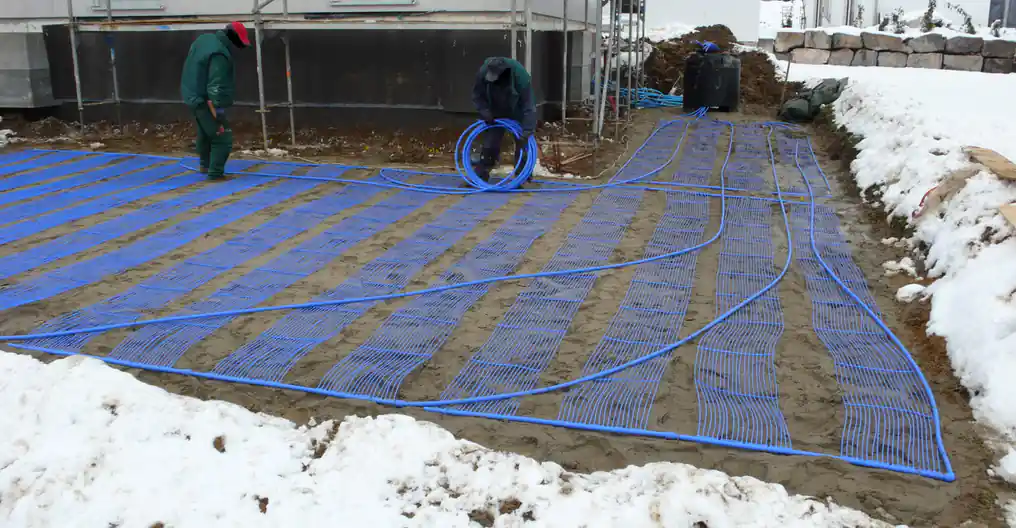
Start with an Hourly Building Load Model
Peak heating and cooling loads determine plant capacity, but they do not fully determine the ground heat exchanger. A commercial borefield also responds to hourly, monthly and annual energy exchange.
The 2025 ASHRAE Handbook chapter on nonresidential load calculations identifies envelope heat transfer, internal gains, ventilation, infiltration, moisture, schedules and system effects as relevant load inputs. In addition, ISO 52016-1:2017, confirmed as current in 2022, provides hourly and monthly calculation procedures for heating, cooling, internal temperature and sensible and latent loads.
A commercial ground source heat pump study should use the following building information.
| Building input | Minimum information required | Status at quotation stage |
|---|---|---|
| Location and weather | Project city, elevation and applicable design weather file | Buyer to provide |
| Heating design load | Building or plant block load at the stated outdoor and indoor conditions | To be calculated by the project engineer |
| Cooling design load | Sensible and latent block loads, including outdoor air and system gains | To be calculated by the project engineer |
| Hourly load profile | At least a representative annual 8,760-hour heating and cooling profile for borefield simulation | Required for final design |
| Monthly energy | Monthly heat extracted from and rejected to the source | Required for annual balance review |
| Occupancy and schedules | Operating hours, holidays, setbacks and future occupancy assumptions | Buyer to provide |
| Ventilation and humidity | Outdoor-air volume, heat recovery, dehumidification and reheat strategy | Project engineer to confirm |
| Domestic hot water | Daily demand, peak draw, storage temperature and priority sequence | Buyer and engineer to confirm |
| Heating-water temperatures | Design supply and return temperatures at peak and part load | Project engineer to confirm |
| Cooling-water temperatures | Chilled-water supply and return temperatures, plus humidity-control requirements | Project engineer to confirm |
| Minimum load | Lowest sustained load and active water volume | To be calculated for cycling and staging review |
| Redundancy | N, N+1, duty/standby or another required arrangement | Buyer to specify |
| Future expansion | Additional floor area, loads or construction phases | Buyer to identify |
| Electrical conditions | Voltage, frequency, phase, available capacity and generator limitations | Buyer to provide |
Floor area can support an early plausibility check. Nevertheless, it cannot replace these inputs. Two buildings of equal size may have very different loads because of glazing, occupancy, ventilation, operating hours, process equipment and hot-water demand.
Peak Capacity and Ground Load Are Not the Same
The ground does not see exactly the same load as the building.
In heating mode, the compressor adds electrical energy to the heat extracted from the ground. Therefore:
Ground heat extraction = Building heating output − Heat pump electrical input
In cooling mode, both the building heat and the compressor input are rejected to the ground:
Ground heat rejection = Building cooling output + Heat pump electrical input
Consider a hypothetical commercial project—not a CASSKY case study. If the building requires 300 kW of heating and the heat pump COP is 4.0 at that exact operating condition, the compressor input is approximately 75 kW. Consequently, the instantaneous ground extraction is approximately 225 kW.
If the same building requires 240 kW of cooling at a cooling COP of 5.0, the electrical input is approximately 48 kW. The ground must then accept approximately 288 kW.
These calculations illustrate the equipment-to-ground relationship only. They do not determine borehole quantity or length. Final sizing must also include load duration, ground properties, borehole resistance, spacing, fluid temperatures, groundwater movement and long-term thermal interaction.
Why Annual Load Balance Matters
A cooling-dominated office, data-intensive facility or retail building may reject more heat into the ground than it extracts. By contrast, a building in a cold climate may have a large annual extraction imbalance.
For example, suppose a hypothetical building rejects 600 MWh to the ground during cooling but extracts only 350 MWh during heating. The annual net rejection is 250 MWh. Repeating this imbalance can progressively raise borefield temperatures unless the field, operating strategy or auxiliary heat-rejection system is designed accordingly.
Possible responses include:
- Increasing borehole length or field spacing
- Recovering heat for domestic hot water or another building
- Using a hybrid cooling tower or dry cooler
- Connecting heating- and cooling-dominated buildings to a shared loop
- Adjusting control sequences to reduce unnecessary simultaneous heating and cooling
- Using seasonal heat rejection or extraction where permitted
However, a hybrid system is not automatically cheaper. Its pumps, fans, water treatment, controls, maintenance and replacement costs must be included in the lifecycle comparison.
Ground Data Required for a Vertical Borefield
A desktop geological review is useful for feasibility, but a commercial design normally needs project-specific site evidence.
| Ground-side input | Why it matters | Evidence boundary |
|---|---|---|
| Undisturbed ground temperature | Establishes the starting source temperature for heating and cooling simulation | To be measured or supported by qualified local data |
| Effective thermal conductivity | Influences the required borehole length and temperature response | Measure through a thermal response test where justified |
| Thermal diffusivity | Affects transient and long-term ground response | Derive from suitable testing or defensible geological properties |
| Borehole thermal resistance | Includes pipe, fluid, grout, geometry and contact effects | Calculate and, where applicable, estimate from the thermal response test |
| Drilling log | Identifies soil, rock, groundwater and construction conditions | Record for every production borehole |
| Borehole depth and diameter | Affect heat-transfer area, drilling method and pressure | Designer to specify; contractor to document as built |
| Borehole spacing | Controls thermal interaction between adjacent boreholes | Determine through field simulation and site constraints |
| Pipe and grout | Affect heat transfer, durability, pressure and environmental compliance | Specify material, dimensions, joining and verification requirements |
| Groundwater movement | May alter effective heat transfer and contaminant pathways | Hydrogeological assessment to confirm |
| Antifreeze | Changes freeze protection, heat capacity, viscosity and pump power | Type and concentration subject to equipment and local requirements |
| Allowed entering-fluid range | Connects the borefield model to heat pump operating limits | Exact model supplier to confirm |
| Source-side flow and pressure loss | Determine pump selection and affect total system efficiency | Calculate for final circuit arrangement and fluid concentration |
ASHRAE’s Ground-Source Heat Pumps and Geothermal Energy chapter explains how thermal property testing can be used to estimate effective ground conductivity and borehole resistance. It also warns, through its design methods, that peak and long-term ground responses occur over different timescales.
A thermal response test is evidence for the tested borehole and test setup. It is not proof that every part of a large site has identical geology. Where conditions vary, the designer should determine whether additional investigations or conservative zoning assumptions are required.
Horizontal Loop Inputs Are Different
Horizontal collectors may avoid deep drilling, but they are more exposed to weather and near-surface conditions.
The design must account for:
- Available undisturbed land
- Soil composition and moisture
- Collector burial depth
- Pipe spacing and arrangement
- Seasonal ground-temperature variation
- Surface drainage and rainfall
- Future paving, landscaping or construction
- Trench access and reinstatement
- Freeze protection
- Manifold location and hydraulic balancing
A horizontal loop is not automatically suitable merely because a site has open land. Dry fill, future development, extensive paving or seasonal drought may undermine the original assumptions.
Conversely, a vertical field is not automatically required for every commercial project. A low-rise building with stable loads and inexpensive excavation may be better served by a horizontal system if the land can remain protected throughout the project life.
Match the Heat Pump to Real Water Temperatures
Heat pump capacity and efficiency change with source-side and load-side temperatures. Therefore, a single headline COP cannot represent annual project performance.
The CASSKY All-in-One Water / Ground Source Heat Pump public page describes a reversible water-to-water platform with:
| Published series information | Public value | Evidence boundary |
|---|---|---|
| Heating capacity | 6–30 kW | Preliminary series range; exact model and condition to be confirmed |
| Cooling capacity | 5–26 kW | Preliminary series range; exact model and condition to be confirmed |
| Heating outlet water | Up to 60°C | Operating limit, not proof of capacity or COP at 60°C |
| Cooling outlet water | Down to 7°C | Exact source temperature, flow and capacity to be confirmed |
| Reference heating COP | Up to 4.8 at B0/W35 | Best published series reference, not every model |
| Reference cooling EER | Up to 5.2 at W30/W7 | Best published series reference; units and test boundary to be confirmed |
| Electrical supply | 220–240 V single-phase or 380–415 V three-phase | Model-specific |
| Control communication | RS485/Modbus RTU | Model-specific |
| Intended public positioning | Villas, apartments and light commercial buildings | Larger commercial architecture requires a separate engineering review |
Here, B0/W35 means a 0°C brine-side reference and 35°C load-side water reference as stated in the CASSKY system guide. W30/W7 indicates a 30°C source-water reference and 7°C chilled-water reference.
These conditions do not represent every commercial project. In particular, a heating system requiring 50–60°C water creates a larger temperature lift than a 35°C underfloor or low-temperature fan-coil system. As a result, capacity and COP will normally differ.
Request a Multi-Condition Performance Matrix
For each proposed model, request capacity and input power at conditions representing the project’s operating envelope.
| Required operating point | Data to request | Project purpose |
|---|---|---|
| B0/W35 | Heating capacity, total unit input and COP | Comparison with the published CASSKY reference condition |
| Project minimum source temperature / W35 | Heating capacity, input, COP and operating status | Verify low-source-temperature heating |
| Project minimum source temperature / project peak outlet temperature | Heating capacity, input and COP | Test the most demanding heating condition |
| W10/W35, if relevant | Heating capacity, input and COP | Compare operation with a warmer water source |
| Project source temperature / DHW condition | Capacity, input, COP and recovery time | Check hot-water production and mode priority |
| W30/W7 | Cooling capacity, input and efficiency | Comparison with the published reference cooling point |
| Project maximum source temperature / W7 | Cooling capacity, input and efficiency | Verify high borefield-temperature cooling |
| 25%, 50%, 75% and 100% load | Capacity, input power, flow and efficiency | Evaluate inverter or staged part-load operation |
| Minimum stable output | Capacity, minimum flow and cycling restrictions | Check low-load operation |
| Standby and crankcase power | Electrical input | Improve annual energy modelling |
| Pump-inclusive condition | Unit plus source- and load-pump input | Compare whole-system performance |
All values should identify the exact model, voltage, frequency, refrigerant, fluid type, antifreeze concentration, flow rate and test standard. Where the manufacturer has not tested a requested condition, the document should identify the value as interpolated, simulated or unavailable.
Laboratory Ratings Are Not Project Yield
ISO 13256-2:2021 establishes testing and rating criteria for factory-made water-to-water and brine-to-water heat pumps. It covers matched equipment assemblies at defined source- and load-side conditions.
Therefore, an ISO 13256-2 test result can substantiate unit capacity, input and efficiency at its stated condition. However, it does not certify:
- Borefield adequacy
- Annual ground-temperature stability
- Source- and load-pump energy
- Building load accuracy
- Terminal performance
- Control-sequence quality
- Installation workmanship
- Annual electricity consumption
AHRI also operates a voluntary Geothermal Water-Source Heat Pump certification programme. Its verified ratings can include capacity, EER, COP and certain part-load values. However, the programme’s public page references the 1998 editions of ISO 13256-1 and ISO 13256-2, whereas ISO published revised editions in 2021. Consequently, an RFQ should identify the edition required by the tender or market instead of stating only “tested to ISO 13256.”
In addition, AHRI performance certification is not safety certification. The AHRI programme’s operations manual explicitly excludes safety criteria.
Separate Performance, Safety and Market Compliance
Different documents answer different questions.
| Evidence type | What it can establish | What it does not establish |
|---|---|---|
| ISO 13256-2 laboratory report | Unit performance under stated water/brine conditions | Borefield performance or annual building energy |
| AHRI directory listing, if applicable | Independent verification of listed product ratings within programme scope | Safety, installation compliance or suitability outside listed conditions |
| IEC 60335-2-40 evaluation | Electrical and refrigerating-appliance safety within the standard’s scope | Heating capacity, COP or local market acceptance by itself |
| National or regional conformity documents | Compliance with specified market requirements | Ground-loop adequacy or project energy use |
| Factory quality records | Production inspections, serial traceability and test completion | Independent certification or field commissioning |
| Borefield simulation | Predicted loop temperatures for stated loads and assumptions | Actual construction quality or future load changes |
| Commissioning records | Installed flow, temperature, power, controls and safety operation | Long-term performance outside the tested period |
The current international appliance safety reference is IEC 60335-2-40:2024 with Amendment 1:2026. Nevertheless, the project must use the edition adopted by its target market and verify whether the proposed model and configuration fall within its scope.
Commercial Plant Configuration and Model Differences
The public CASSKY range extends to a preliminary 30 kW heating capacity. Therefore, a larger commercial ground source heat pump project may require multiple modules or a different equipment family.
For a modular plant, buyers should verify:
- Maximum permitted number of units in one cascade
- Lead–lag and run-hour rotation
- Duty/standby sequence
- Minimum and maximum common-loop flow
- Hydraulic separation
- Buffer volume
- Isolation valve control
- Staging dead bands
- Simultaneous heating, cooling and DHW limitations
- Communication protocol and register map
- Alarm handling when one module is unavailable
- Plant-controller supply boundary
- Combined starting current and electrical demand
- Service clearance and equipment replacement route
Do not assume that RS485 or Modbus capability automatically provides complete cascade control. A communication port, a controller function and a documented building-management-system interface are different deliverables.
Similarly, do not multiply one module’s headline capacity by the proposed quantity without checking diversity, defrost or changeover logic, flow conditions, control limitations and the capacity at the project water temperatures.
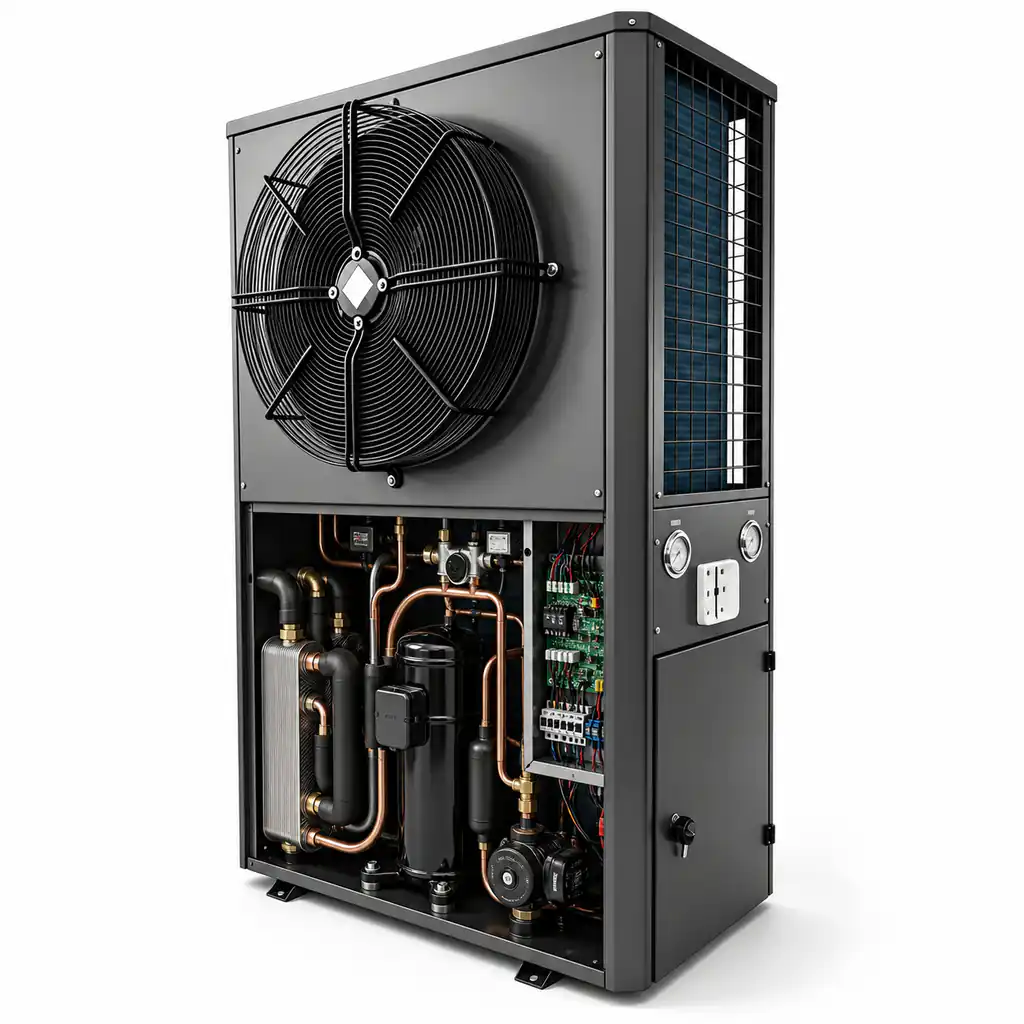
Terminal-System Compatibility
Low-temperature distribution generally reduces the temperature lift required from the heat pump. Therefore, underfloor heating, appropriately selected fan coils and low-temperature air-handling coils can support better operating conditions than undersized legacy radiators requiring high water temperatures.
However, terminal compatibility must be calculated rather than assumed.
The engineer should confirm:
- Heating output at the proposed supply and return temperatures
- Cooling output at the proposed chilled-water temperatures
- Latent cooling and dehumidification
- Condensation protection for radiant cooling
- Minimum and maximum terminal flow
- Valve authority and variable-flow behaviour
- Pump head at design flow
- Minimum system water volume
- Buffer-tank requirement
- Freeze protection during shutdown
- Domestic-hot-water priority and auxiliary heating
A unit capable of producing water “up to 60°C” is not automatically suitable for a 60°C commercial heating system. The decisive evidence is its capacity, input power, COP and operating envelope at the specified source and load temperatures.
When a Commercial Ground Source Heat Pump Is a Good Fit
The technology is more likely to be appropriate when:
- The building has stable, long-term heating and cooling demand
- The site can accommodate a verified ground heat exchanger
- The owner expects to operate the facility long enough to evaluate lifecycle cost
- Low- or moderate-temperature building terminals are practical
- Drilling or excavation can be coordinated before site access becomes restricted
- The project has qualified ground-loop and controls designers
- The electrical system can support the selected plant
- The owner can maintain pumps, filters, controls and water chemistry
- Heating- and cooling-dominated loads can be balanced or managed
- The project values indoor equipment and reduced dependence on exposed outdoor heat exchangers
In addition, campuses with simultaneous heating and cooling may benefit from shared-loop heat recovery, provided the load diversity and control strategy are properly modelled.
When Another Solution May Be More Appropriate
A ground-source system may be a poor fit when:
- The project lacks drilling rights or environmental approval
- The available ground area cannot support the required field
- The building will be occupied only temporarily
- The load or operating schedule remains undefined
- High-temperature terminals cannot be replaced and performance at the required temperature is unacceptable
- A deep aquifer causes excessive pumping energy
- The site has highly variable geology that has not been investigated
- The owner cannot protect the ground field from later construction
- The project schedule does not allow site testing and borefield installation
- The business case depends on an unverified “metres per kilowatt” rule
- The supplier is expected to guarantee annual performance without control over the borefield, loads, pumps or terminals
For example, a small leased building with a short remaining tenancy may not justify a permanent borefield. Conversely, a hospital or campus with long operating hours may justify a more detailed lifecycle analysis even when the initial civil cost is higher.
Minimum Design Deliverables Before Purchase
A commercial order should not be released solely against a product brochure. At minimum, obtain or assign responsibility for the following:
Building and Energy Documents
- Heating and cooling load calculation
- Hourly annual load file
- Monthly heat extraction and rejection summary
- Terminal-water temperature schedule
- Domestic-hot-water load and priority sequence
- Electrical load schedule
- Plant redundancy and expansion basis
Ground Heat Exchanger Documents
- Geological and hydrogeological review
- Thermal response test report where required
- Borefield or collector simulation
- Entering- and leaving-fluid temperature limits
- Borehole or trench layout
- Pipe, grout and antifreeze specification
- Hydraulic pressure-loss calculation
- Pump selection
- Drilling, pressure-test and flushing procedures
Heat Pump Documents
- Exact model datasheet: request
- Multi-condition capacity and input table: request
- Performance test report for the offered model: request
- Applicable product certificates and market documents: request
- Refrigerant and charge information: request
- Electrical diagram: request
- Hydraulic connection diagram: request
- Controller and Modbus documentation: request
- Cascade-control limits: request
- Installation, operation and maintenance manual: request
A report for a related model is not automatically evidence for the offered model. Check the model number, voltage, refrigerant, compressor, heat exchangers and certification scope.
Commissioning Acceptance Conditions
Commissioning should verify measurable system behaviour, not merely prove that the compressors can start.
The acceptance plan should record:
- Source-side entering and leaving fluid temperatures
- Load-side entering and leaving water temperatures
- Actual source- and load-side flow
- Antifreeze type and measured concentration
- Pressure drop across the ground circuit and equipment
- Heat pump electrical input
- Source- and load-pump electrical input
- Calculated field heating or cooling output
- Staging and lead–lag sequence
- Minimum-load operation
- DHW priority and recovery operation
- Low-flow, freeze and high-temperature protection
- Sensor plausibility and calibration status
- Alarm history and reset behaviour
- BMS communication
- Borefield circuit balancing
- Control-parameter backup
- As-built borehole or collector records
ASHRAE/IES Standard 202-2024 provides a commissioning framework based on the Owner’s Project Requirements, design documents, verification procedures and system records. The project should convert that process into system-specific acceptance criteria.
If the measured temperatures and flow are used to calculate heat output, the contract should state the required sensor accuracy, measurement method, stabilisation period and allowable tolerance. Otherwise, apparently precise field results may not be comparable with laboratory ratings.
Buyer Decision Checklist
A proposal is ready for serious evaluation only when the buyer can answer “yes” to the following questions:
- Is the exact heat pump model identified?
- Is its capacity shown at the project source and load temperatures?
- Are input power and performance boundaries clearly defined?
- Has the building load been calculated rather than estimated only from floor area?
- Is an hourly or monthly ground-load profile available?
- Are ground conductivity and borehole resistance based on suitable evidence?
- Has long-term ground-temperature drift been simulated?
- Are source and load pump powers included in the energy comparison?
- Is the terminal system compatible with the selected water temperatures?
- Is the modular control sequence documented?
- Are product testing, safety certification and market compliance clearly separated?
- Are borefield, equipment, hydraulics and controls responsibilities assigned?
- Are commissioning measurements and tolerances written into the contract?
- Are all assumptions, exclusions and supplier-confirmed values visible?
If several answers remain “no,” comparing equipment prices is premature.
Frequently Asked Questions
How many boreholes does a commercial ground source heat pump need?
There is no universal number of boreholes per kilowatt. The answer depends on ground conductivity, borehole resistance, depth, spacing, peak ground load, annual imbalance, allowable fluid temperatures and project life. A project-specific simulation is required.
Is a thermal response test always required?
Not necessarily. Its value depends on project size, geological uncertainty, borefield cost and risk. However, using generic ground properties for a large commercial field can create significant sizing uncertainty. The engineer should document why a test is required or why verified local evidence is sufficient.
Can the heat pump manufacturer design the borefield?
Only if that service is explicitly included and performed by qualified personnel using appropriate site and load data. Equipment selection and borefield design are separate responsibilities unless the contract combines them.
Is the highest COP model always the best choice?
No. COP must be compared at the same source temperature, outlet-water temperature, flow and test boundary. Whole-system energy must also include ground-loop pumps, load pumps, controls and auxiliary equipment.
Can multiple smaller heat pumps serve a large commercial building?
Possibly. Modular plants can improve staging and redundancy. However, the supplier must confirm cascade limits, common-loop hydraulics, controller functions, electrical demand and performance at the project conditions.
Can a ground loop be sized from peak heating load alone?
No. Peak heating, peak cooling, load duration, monthly energy and long-term heat imbalance all affect the design. Sizing only from the largest peak can overlook long-term ground-temperature drift.
Does a maximum 60°C outlet make the CASSKY platform suitable for high-temperature radiators?
Not by itself. Request the exact model’s heating capacity, input power and COP at the required source and outlet-water conditions. Also verify radiator output and auxiliary-heating requirements.
Submit the Right Inputs for Preliminary Selection
For a preliminary CASSKY equipment review, submit:
- Project country and city
- Building type and conditioned area
- Design heating and cooling loads
- Hourly or monthly load data, if available
- Domestic-hot-water demand
- Proposed vertical, horizontal, pond or groundwater source
- Geological or thermal response information
- Minimum and maximum source-fluid temperatures
- Heating and cooling supply and return temperatures
- Source- and load-side design flow
- Antifreeze type and concentration
- Electrical supply
- Redundancy and modular staging requirements
- Modbus or remote-monitoring requirements
- Estimated unit quantity
- Required test reports, certificates and market documents
CASSKY can then review candidate equipment, operating conditions and the model-specific information that must be requested. Final building, borefield, hydraulic, electrical and controls design must remain with appropriately qualified project professionals.