
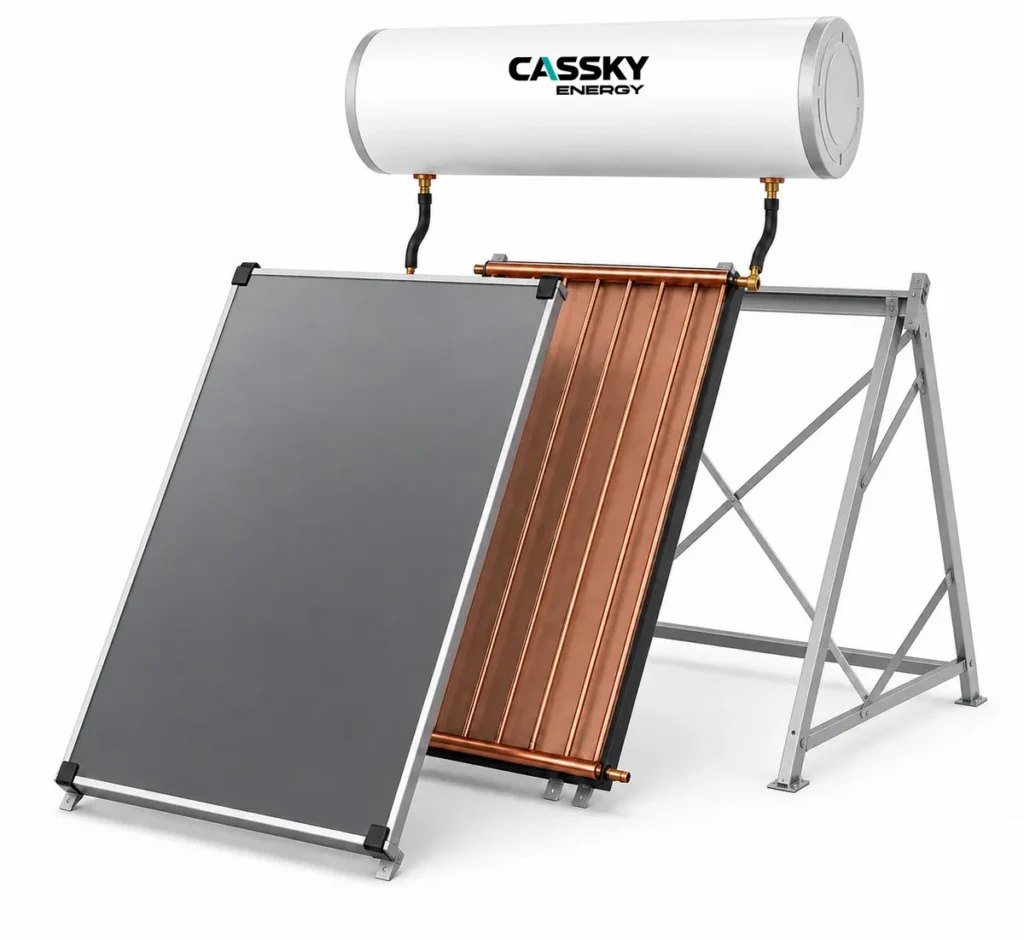
A flat-plate solar collector should be selected as part of a complete thermal system. The collector captures heat, but the project still needs a mounting structure, hydraulic circuit, pump or thermosiphon arrangement, storage, controls, safety devices, backup heat and a defined hot-water load. A panel quantity by itself is not a design. For complete pressurized hot-water selection, see CASSKY’s pressurized flat-plate solar water-heater project guide.
This article covers collector mounting, array hydraulics, protection and the RFQ evidence needed to integrate a collector field. The linked project guide covers the broader pressurized water-heater system selection. Keeping those roles separate helps prevent a collector-only quotation from being treated as a complete hot-water package.
This guide is for distributors, EPC contractors, engineers and project owners evaluating flat-plate solar collectors for commercial hot water or other low- to medium-temperature applications. It explains the information needed before an array is quoted and the design checks that affect useful output, service life and installation risk.
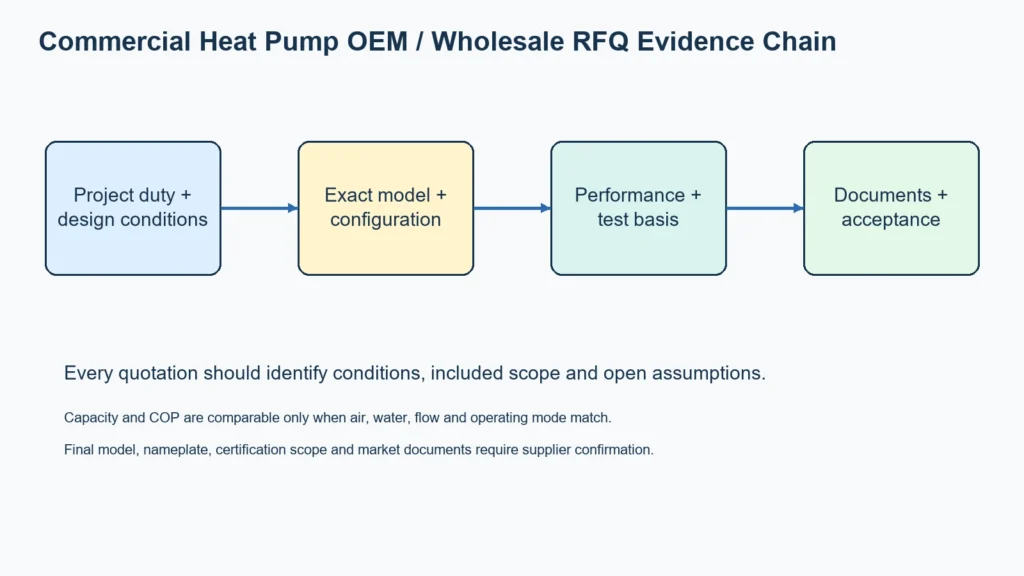
Collector field, hydraulic balance, storage and protection must be designed as one system.
The short answer: how should a flat-plate collector system be planned?
Use this order:
- Define the hot-water or thermal load and the required delivery temperature.
- Confirm the collector product boundary: collector only, or a complete water-heating package.
- Survey the site for solar resource, shading, roof structure, access and weather exposure.
- Select the collector type and tested performance at the required operating temperature.
- Lay out the array so parallel branches receive the intended flow.
- Design storage, heat exchangers, controls, expansion, pressure relief and backup heat.
- Check freeze protection, stagnation, scald protection, water quality and maintenance access.
- Put the design conditions, documents and acceptance method into the RFQ.
1. Define what the collector supplies
A flat-plate solar collector is a glazed heat-collection panel with an internal liquid circuit. It transfers solar energy to water or a specified heat-transfer fluid. It is not automatically a complete solar water heater.
| Item | Collector module | Complete solar water-heating system |
|---|---|---|
| Main supplied item | Glazed panel, absorber, internal fluid circuit and connections | Collector, tank, frame, hydraulic equipment, controls and safety components |
| Main selection basis | Gross or aperture area, absorber construction, pressure, connections and tested performance | Hot-water demand, storage volume, pressure arrangement, controls and local code |
| Typical integration | External pump station, heat exchanger and storage | Factory-defined package or engineered system |
| Buyer question | Can the collector deliver useful heat at the project condition? | Can the complete system deliver safe hot water on the required schedule? |
Do not use tank litres as a substitute for collector performance. Conversely, do not select a collector without checking the storage and load profile that will receive its heat.
CASSKY collector reference data
CASSKY’s current collector page describes a collector-only product boundary and gives 2.0–3.0 m² reference gross-area options for the listed model family. The page also identifies water or glycol circuits, mounting options and model-dependent performance data. Treat those values as market-reference information until the exact model, optical data, pressure rating, certification scope and destination-market documents are confirmed in the supplier offer. Review the CASSKY flat-plate collector page.
| Reference item | Published planning basis | Evidence boundary |
|---|---|---|
| Collector gross area | 2.0–3.0 m² reference options | Exact model to confirm |
| Circuit | Water or water-glycol reference | Fluid compatibility to confirm |
| Mounting | Pitched or flat-roof reference options | Structural fixing and site loads to confirm |
| Performance and certification | Model and market dependent | Request exact test and conformity documents |
2. Collect the project inputs before sizing the array
The following inputs should be available before a supplier recommends a collector count:
| Input | What to provide | Why it matters |
|---|---|---|
| Location | City, latitude, climate, design season and solar resource | Determines useful solar availability and weather exposure |
| Load | Daily volume, hourly draw profile and incoming-water temperature | Determines energy demand and storage recovery |
| Target temperature | Delivery, storage, return and recirculation temperatures | Changes collector operating temperature and efficiency |
| Site | Roof or ground area, shading, orientation, tilt, access and drainage | Sets the usable array area and installation constraints |
| Structure | Roof build-up, allowable load, wind and snow exposure | Determines the mounting and fixing design |
| Hydraulic loop | Direct water, closed loop or water-glycol circuit | Affects materials, pressure, pumping and freeze protection |
| Interfaces | Tank, heat exchanger, backup source, BMS and electrical supply | Defines the system control and equipment scope |
| Compliance | Plumbing, pressure, structural, electrical and certification requirements | Prevents a technically suitable collector from being unusable in the destination market |
For a hotel, dormitory, sports facility or factory, ask for an hourly or grouped demand profile. A daily total can hide a short morning peak that requires storage and recovery capacity.
3. Design the mounting and collector field
The mounting system has to support the collector and preserve the roof or ground installation. Check the following points with the structural and building teams:
- roof load, fixing points, waterproofing and access routes;
- wind uplift, snow load, seismic requirements and corrosion exposure;
- collector tilt, orientation and row spacing;
- shading from parapets, plant equipment, adjacent buildings and future construction;
- safe access for tube, glazing, gasket, connection and valve service;
- lifting, staging and replacement routes;
- drainage and protection from standing water;
- clearance for expansion, pipe insulation and thermal movement.
There is no universal “best” angle. A commercial array should balance seasonal solar demand, local latitude, roof geometry, wind and snow, shading, access and the temperature required by the load. The final mounting angle and fixing method belong in the approved structural and solar design.
The array layout should also leave a clear service zone. A dense layout that maximizes gross area can reduce inspection access, make branch balancing difficult and increase replacement cost.
4. Balance the hydraulic layout
Commercial output comes from a correctly sized and balanced array. Collector count alone does not define performance. Flow rate, branch resistance, pipe length, elevation, insulation, control logic and storage temperature all affect the heat delivered to the system.
For parallel banks, the designer should define:
- the intended flow range for each collector or branch;
- the number of collectors allowed in series or parallel;
- supply and return headers;
- balancing valves or another approved balancing method;
- pump head at design flow;
- pipe size, pressure drop and insulation;
- air removal, drain points and isolation valves;
- sensor locations and control logic.
If branch resistance is different, some collectors may receive too much flow while others receive too little. The result can be uneven temperature, lower useful output, difficult commissioning and misleading performance comparisons. A hydraulic schematic and branch schedule should be part of the supplier response.
5. Select the heat-transfer fluid and safety strategy
The loop may use direct water, a closed water loop, water-glycol or another approved heat-transfer arrangement. The choice depends on climate, collector materials, working temperature, potable-water separation, local practice and the selected product.
Freeze protection
For locations where the collector loop can freeze, confirm the fluid, concentration, low-temperature design, expansion volume, pump controls, drain-down or recirculation strategy and service procedure. Do not infer a collector’s freeze capability from another model or supplier.
Stagnation and over-temperature protection
Solar input can continue when the storage tank is full or the pump is stopped. The design should state how it handles high collector temperature, including expansion, pressure relief, heat dumping, drain-back, protective controls and the allowable operating range of the fluid and materials.
ISO 9806:2025 defines test methods for thermal performance, durability, reliability and safety of fluid-heating solar collectors. A test standard does not remove the need to check local building, plumbing and structural requirements for the installation.
Water quality and potable-water separation
Check the collector, heat exchanger, seals, piping and tank materials against the project’s water quality and treatment. Where the collector loop is not suitable for potable water, use the specified heat exchanger and keep the primary and secondary circuits separated.
6. Match storage to the load profile
Storage is the link between variable solar input and a time-varying hot-water load. The design should show:
- usable tank volume rather than only nominal volume;
- storage temperature range and stratification approach;
- heat-exchanger capacity and temperature difference;
- morning, evening and peak draw periods;
- recirculation losses;
- backup-heater capacity and control sequence;
- collector pump start and stop logic;
- high-temperature and scald protection;
- expected recovery after a cloudy period or peak draw.
The collector should not be sized from annual solar energy alone. The hourly load, storage temperature and available solar resource determine how much of the collected heat can be used. A system can have a good annual balance and still require backup heat during the daily peak or a winter sequence.
7. What should be in a commercial collector RFQ?
Ask each supplier to return the same information:
| RFQ section | Required response |
|---|---|
| Collector identity | Exact model, collector type, gross area, aperture area and absorber construction |
| Performance | Test method, efficiency parameters, operating range, pressure and thermal performance at stated conditions |
| Hydraulic data | Recommended flow, pressure drop, connection size, permitted array layout and fluid compatibility |
| Mechanical data | Dimensions, weight, frame, fixing method, roof loads and service clearances |
| Protection | Freeze, stagnation, expansion, relief and drain-down or heat-dump strategy |
| System scope | Pump station, heat exchanger, storage, controls, valves, insulation and backup interfaces |
| Compliance | Applicable certificates and documents for the destination market and exact model |
| Commercial terms | Quantity, packaging, spare parts, documentation, lead time and commissioning scope |
Request drawings, performance data, installation instructions, maintenance requirements and a list of exclusions. “Collector only” and “complete system” quotations should not be compared as though they have the same scope.
8. When is a flat-plate collector a suitable choice?
Flat-plate collectors can be suitable when the project has a useful solar resource, available mounting area, a compatible temperature requirement and a practical way to store and use the heat. They are often evaluated for domestic or commercial hot water, low-temperature heating support and pool heating applications.
Compare them with evacuated-tube or other collector architectures using the same load, climate, operating temperature, aperture or gross-area basis, maintenance plan and installed scope. A technology comparison is only useful when the test conditions and system boundaries match.
Frequently asked questions
Does a flat-plate collector include a hot-water tank?
Not necessarily. A collector module may need an external tank, pump station, controller, heat exchanger and safety components. Confirm the exact supply scope before comparing quotations.
Can collectors be connected in parallel?
Usually, array layout can include parallel branches, but the permitted arrangement, flow range, pressure drop and balancing method must be confirmed for the selected model.
Is direct water always the simplest loop?
No. Direct water may be unsuitable where freezing, water quality, pressure or potable-water separation creates a risk. The project designer must select the complete loop and protection strategy.
How much storage is required?
Storage depends on the load profile, target temperature, collector output, backup source, control strategy and local design assumptions. A tank size should not be chosen from collector area alone.
Request a CASSKY collector selection
Send CASSKY the project location, daily and peak hot-water demand, target delivery temperature, roof or ground layout, shading, circuit type, storage concept, required certifications and delivery market. CASSKY can then discuss the appropriate collector configuration, array layout and system interfaces for preliminary project selection.
View CASSKY flat-plate solar collectors or send the project requirements.