CPC Evacuated Tube Collector
- Evacuated tube absorber assembly
- CPC reflector behind the tubes
- Insulated manifold and heat-transfer circuit
- Mounting structure and collector connections
- Designed as one module in a larger solar loop

Home / Evacuated Tube Solar Collectors / CPC Evacuated Tube Solar Collector
A modular solar thermal collector combining evacuated tubes, a heat-transfer manifold and compound parabolic reflectors to capture direct and diffuse solar radiation for hot-water and supplementary-heating systems.
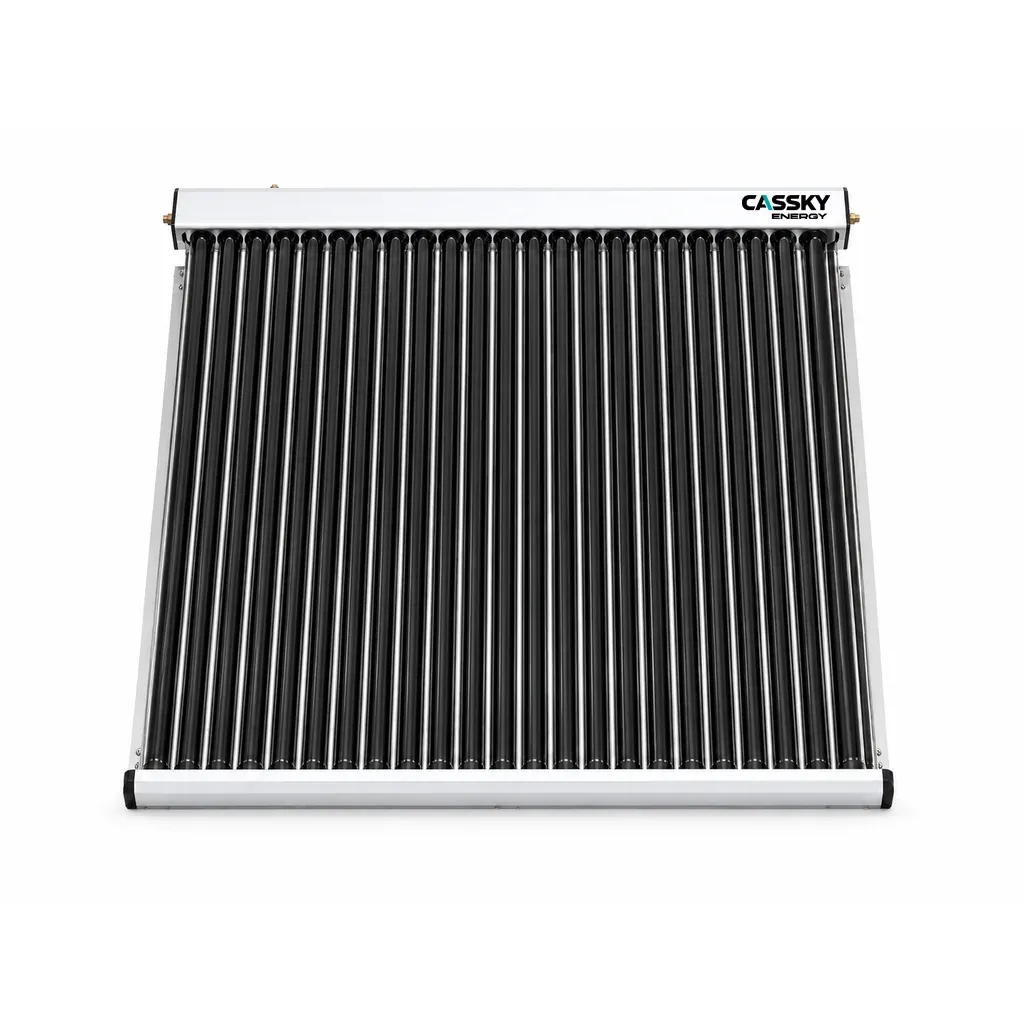
This distinction matters for engineering, quotations and SEO. A CPC collector supplies captured thermal energy to a designed system; it does not store or deliver domestic hot water by itself.
A weather-resistant shaped reflector is positioned behind each evacuated tube to redirect solar radiation that would otherwise pass between tubes or arrive at less favourable angles.
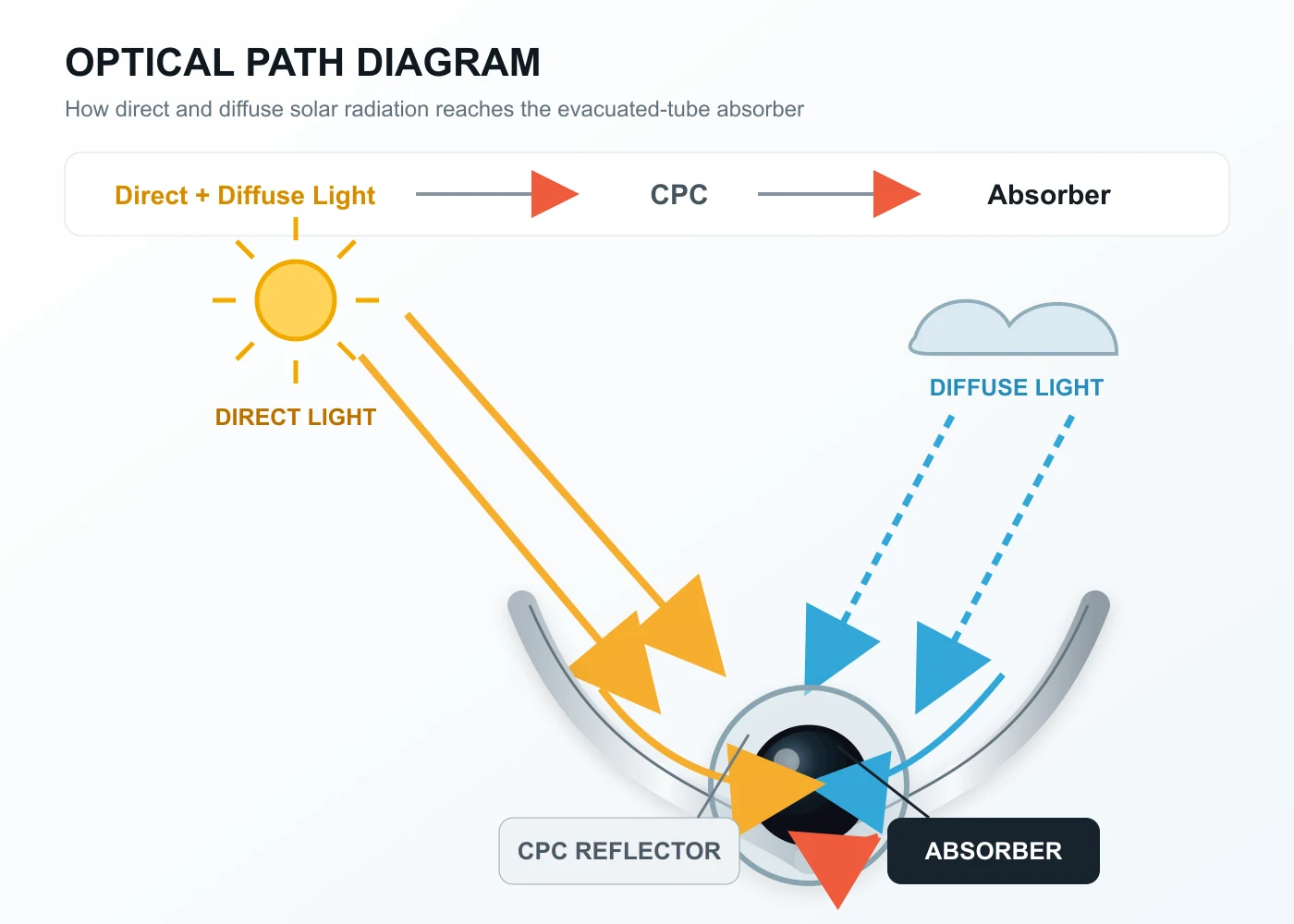
Direct and diffuse sunlight reaches the collector across changing incidence angles.
The reflector geometry sends additional radiation toward the tube absorber surface.
The evacuated space insulates the selective absorber and reduces convective heat loss.
The selected heat-transfer architecture moves collected energy into the external solar circuit.
Double-wall borosilicate tubes protect the selective absorber within a vacuum-insulated space.
Reduced environmental heat lossShaped reflective surfaces recover radiation from the gaps and redirect it toward the absorber.
Improved use of collector footprintHeat-pipe, U-pipe or direct-flow architectures may be developed as separate configurations.
System-specific hydraulic designThe header gathers heat from the tube array and connects the module to the external circuit.
Centralized collector connectionA structural frame supports the tube, reflector and manifold assembly for roof or rack mounting.
Repeatable array installationSelected designs allow individual tube or reflector service without replacing the complete array.
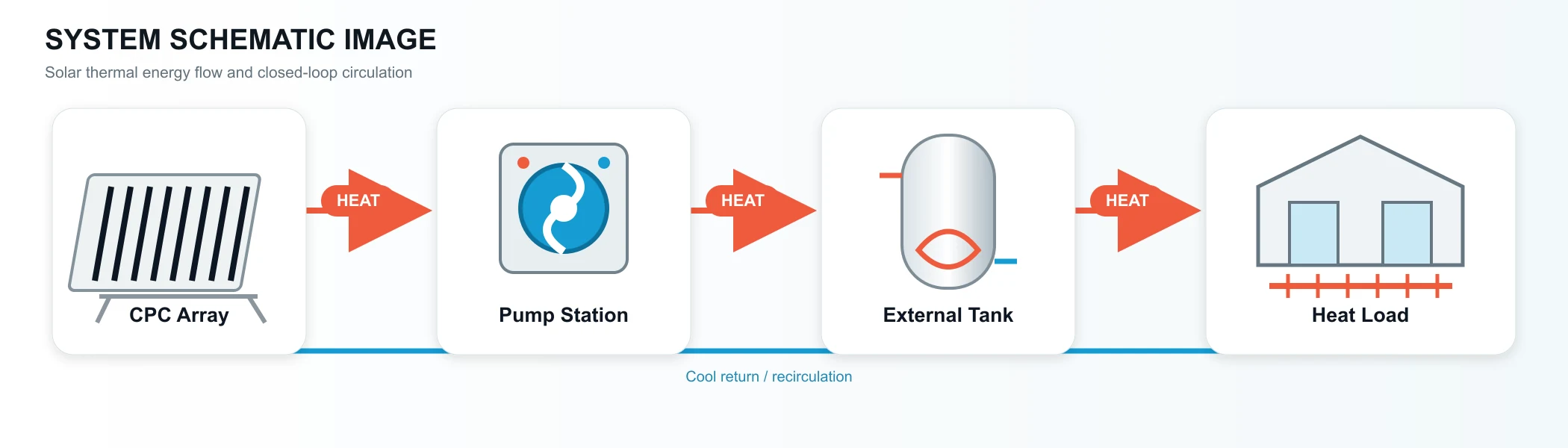
Lower service-part burdenThe collector array must be hydraulically and thermally matched to the storage volume, load profile, climate, heat exchanger and backup source.
| Parameter | Common Reference / Option | Publication Requirement |
|---|---|---|
| Collector Type | CPC evacuated-tube module | Define heat-pipe, U-pipe or direct-flow architecture. |
| Common Tube Series | 6 / 8 / 10 / 12 / 14 / 15 / 16 / 18 / 20 / 22 / 24 | Available Cassky series requires confirmation. |
| Common Tube Format | Ø58 × 1800 mm* | Must match the final manifold and reflector design. |
| Aperture Area | Approx. 1–3 m² module classes* | State the certified value for each model. |
| Gross Area | Model-dependent | Publish exact module dimensions and gross area. |
| CPC Reflector | Formed reflective aluminium option | Material, coating and reflectance require confirmation. |
| Manifold | Insulated metal housing | Header material and insulation must be specified. |
| Heat-Transfer Medium | Water or water-glycol, design-dependent | Follow local freeze-protection and material requirements. |
| Working Pressure | Architecture-dependent | Never infer pressure rating from another supplier. |
| Connections | Threaded or project-specific | Size, standard and array connection require confirmation. |
| Installation Angle | Project-dependent | Confirm orientation, roof load, wind and snow conditions. |
| Certifications | Market-dependent | List only certificates issued for the exact Cassky model. |
Collector arrays connected to external storage for hotels, dormitories and facilities.
Solar contribution to low-temperature hydronic systems subject to engineering review.
Indirect solar heating through an appropriately selected heat exchanger and controls.
Preheating applications evaluated from load temperature, operating hours and climate.
OEM development can focus on the module architecture, reflector, manifold, connection standard, frame, label, packaging and service-parts plan.
Technical and purchasing questions about CPC collector modules and their use in complete solar thermal systems.
No. It is a collector module. The storage tank, pump station, controller, heat exchanger and safety components are designed separately.
The compound parabolic reflector redirects additional direct and diffuse radiation toward the evacuated-tube absorber, including light that would otherwise fall between tubes.
Selection is based on aperture area and tested performance together with climate, load temperature, daily energy demand, storage, roof area and system losses—not tank litres.
Yes, subject to model-specific pressure drop, permitted series length, flow balancing, pipe sizing and control design. The final array must be engineered.
A suitable closed-loop water-glycol design may be considered, but freeze protection depends on the entire system, fluid concentration, controls and installation details.
No. They are different heat-transfer architectures with different hydraulic and service characteristics. The exact Cassky configuration must be identified in the model datasheet.
Potential options include module size, tube count, transfer architecture, reflector, manifold, connections, frame, labeling, manuals and packaging, subject to engineering and order terms.
Provide destination country, application, design temperatures, daily load, roof area, storage concept, required certifications, quantity and delivery plan.
Cassky specializes in high-performance heat pump systems and solar energy solutions, providing reliable products and customized services for global distributors, engineering companies, contractors, and brand partners.
Tell us about your product or project requirements. Our team will contact you to discuss the next step.