
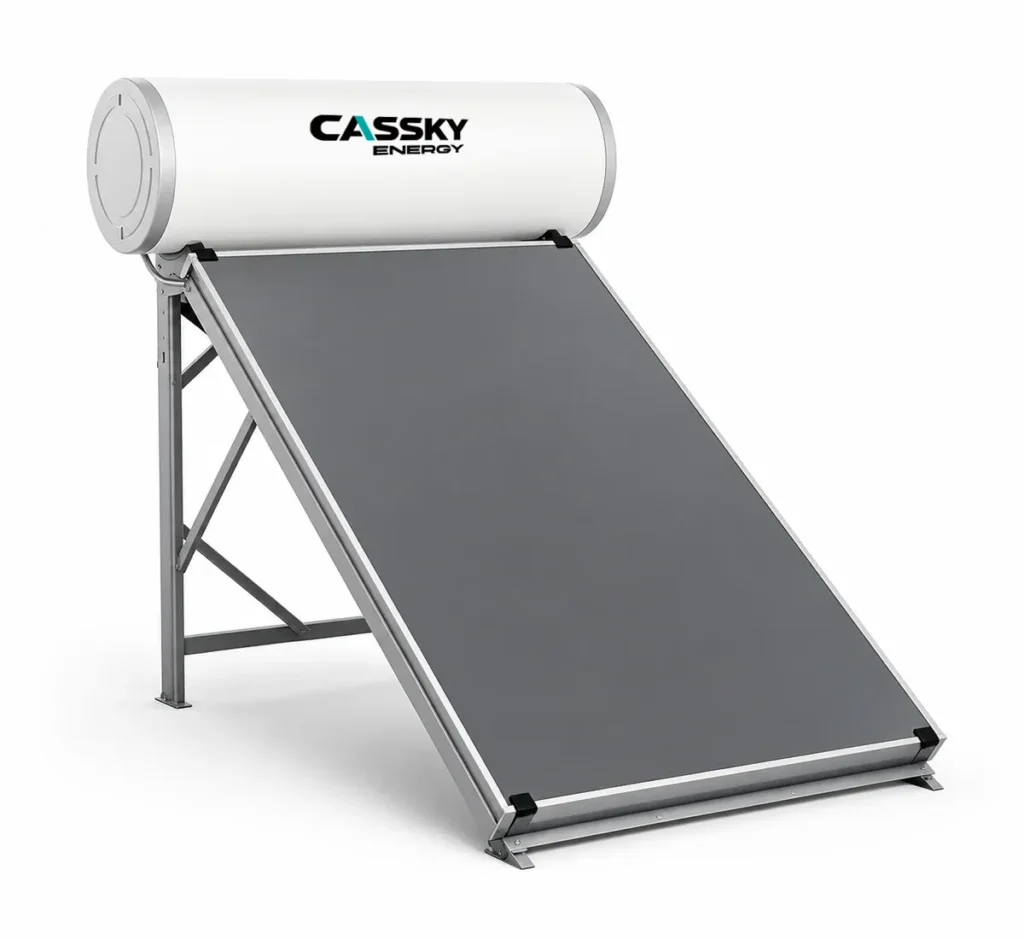
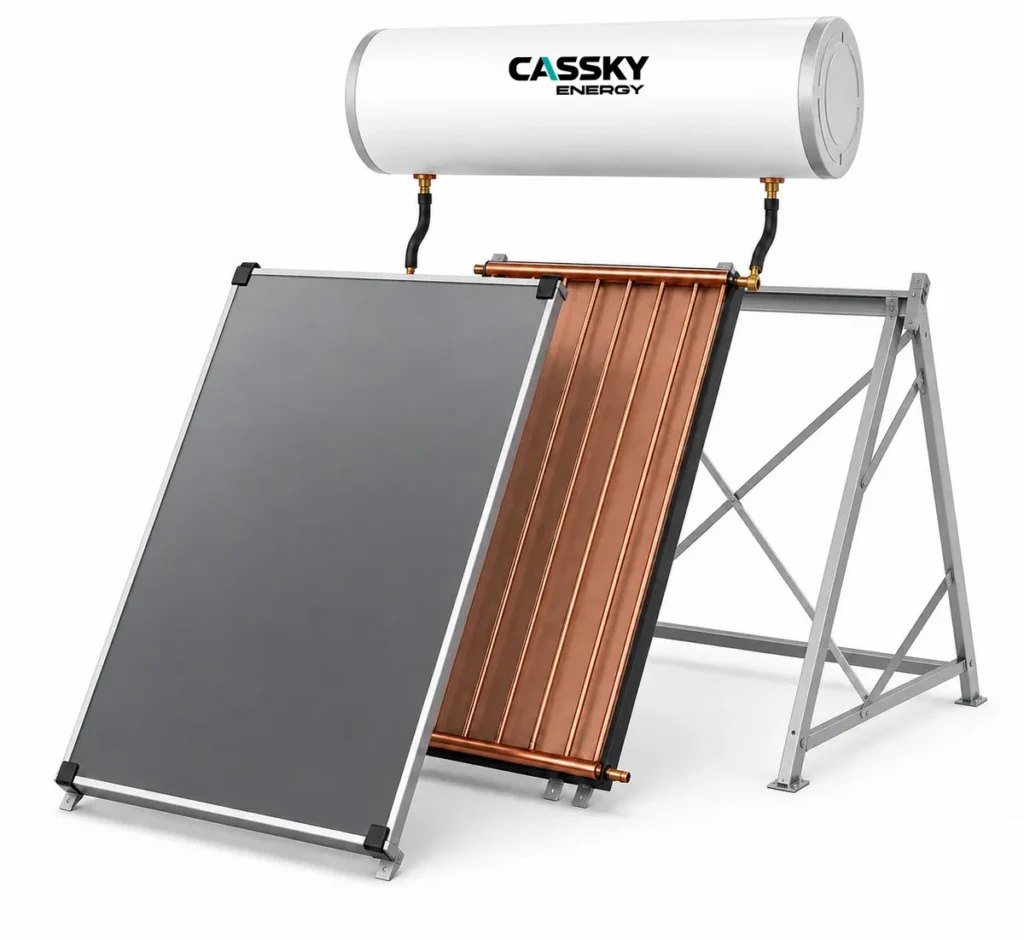
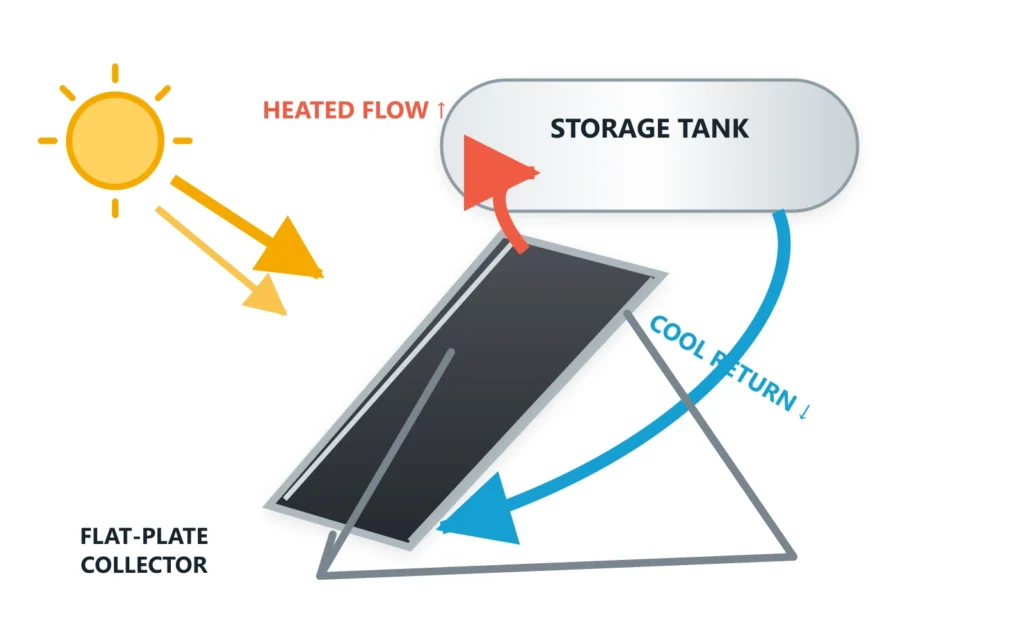
A pressurized flat-plate solar water heater combines a flat-plate collector, insulated storage tank, and mounting frame in one roof-mounted hot-water system. Solar radiation heats the fluid inside the collector. The warmer fluid becomes less dense and rises, while cooler fluid returns to the collector, creating natural thermosiphon circulation without a circulation pump. A pressure-rated tank supplies hot water at a pressure related to the incoming mains supply.
This simple, coordinated arrangement can suit detached homes, villas, staff housing, low-rise residential developments, and some light commercial applications. Successful operation still depends on hot-water demand, solar resource, collector area, storage volume, inlet pressure, water quality, roof structure, freeze protection, stagnation control, and auxiliary heating.
Quick Answer: What Must Be Confirmed Before Purchase?
Answer these ten questions before comparing models and prices:
- How many litres of hot water are required each day, and when do the peak draws occur?
- What are the cold-water, storage, and point-of-use temperatures?
- What share of the annual water-heating load should solar energy provide, and which source will supply the balance?
- How much unshaded collector area is available, and what are the roof orientation and tilt?
- Will potable water circulate directly through the collector, or will an indirect jacket or coil separate the solar loop?
- Does the minimum site temperature require antifreeze, drainback, or another approved freeze-protection method?
- Do the mains pressure, system working pressure, and safety-valve settings match?
- Can the roof support the full tank, collector, frame, wind load, and snow load?
- How will the system manage stagnation and overheating during periods of high solar gain and low water use?
- Can the supplier provide model-specific performance, pressure, material, certification, and installation documents?
Selecting a 150 L, 200 L, or 300 L tank from occupancy alone does not complete the design. Storage volume, collector area, daily draw, local solar radiation, and auxiliary heating must be evaluated together.
What Do Pressurized, Flat Plate, and Thermosiphon Mean?
Pressurized
The tank and connected water circuit in a pressurized system operate within a defined pressure range. Incoming water pressure normally pushes hot water to the outlets. The project must verify maximum inlet pressure, working pressure, test pressure, pressure-reducing requirements, check valves, thermal expansion control, and temperature-and-pressure relief. “Pressurized” does not mean that the product can connect safely to every mains supply without hydraulic review.
Flat Plate
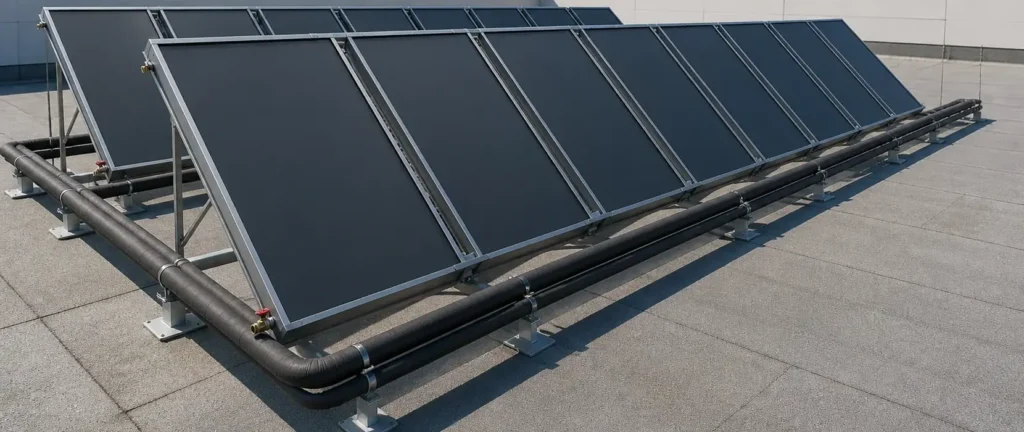
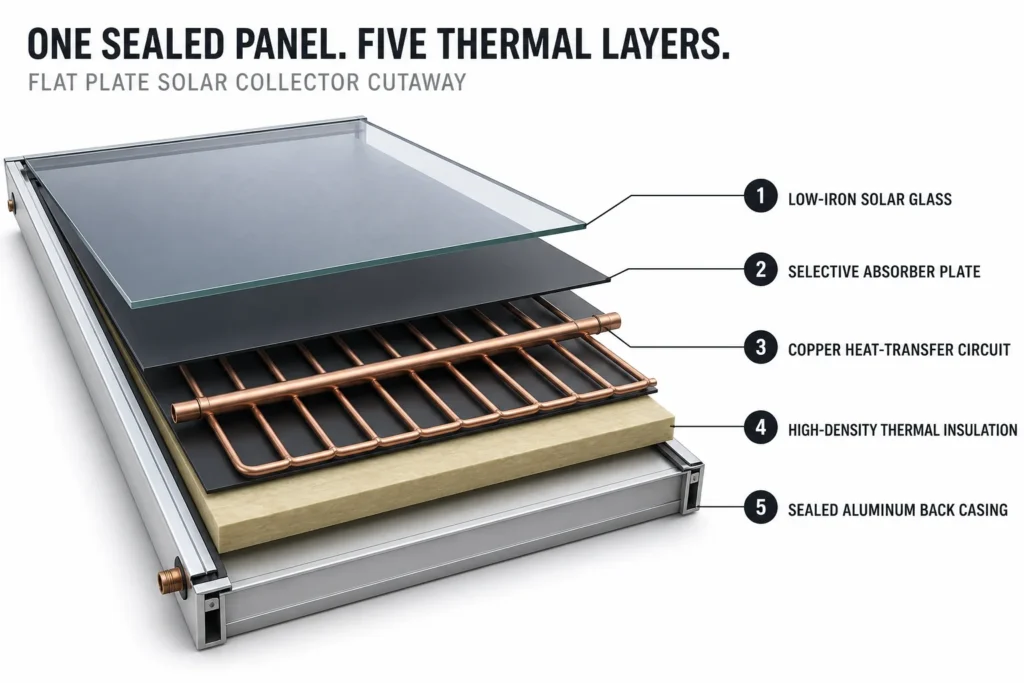
A flat-plate collector normally includes transparent glazing, a selectively coated absorber, fluid channels, insulation, and a protective casing. It converts solar radiation into heat carried by the circulating fluid.
Collector efficiency changes with solar irradiance, ambient temperature, and mean fluid temperature. An absorber coating value or one unsupported efficiency percentage cannot represent annual system output.
ISO 9806:2025 specifies test methods for the thermal performance, durability, reliability, and safety of fluid-heating solar collectors. The standard also states that a device in which collection and integral storage cannot be separated for collector testing requires a suitable whole-system assessment. ISO 9806:2025
Thermosiphon
A thermosiphon system relies on natural convection. Fluid heated in the collector becomes less dense and rises into the elevated tank, while cooler fluid returns to the collector. The U.S. Department of Energy’s Building Science Education resource describes the same passive process and notes that the storage tank sits above the collector. DOE Building Science Education: Thermosiphon Solar Water Heaters
This circulation method removes the pump and simplifies controls, but it makes tank elevation, connection positions, pipe slope, pipe diameter, air removal, and reverse-flow prevention critical. Poor installation geometry can cause weak circulation, slow heating, air locks, or heat loss through nighttime reverse circulation.
Step 1: Decide Whether the Product Fits the Project Scale
| Project type | Initial suitability | Main selection issues |
|---|---|---|
| Villa or detached home | Common application for an integrated pressurized thermosiphon system | Daily demand, roof load, mains pressure, freeze protection, and electric backup |
| Townhouses or repeated housing units | One standardized system can be assigned to each home | Different occupancy levels, repeatable installation, pipe length, roof layout, and centralized maintenance |
| Small guesthouse or staff accommodation | Can be assessed by zone or room group | Peak demand, consecutive cloudy days, backup recovery, and service continuity |
| School accommodation or small apartment building | Compare several modular heaters with a centralized system | Simultaneous draw, roof space, number of service points, and water management |
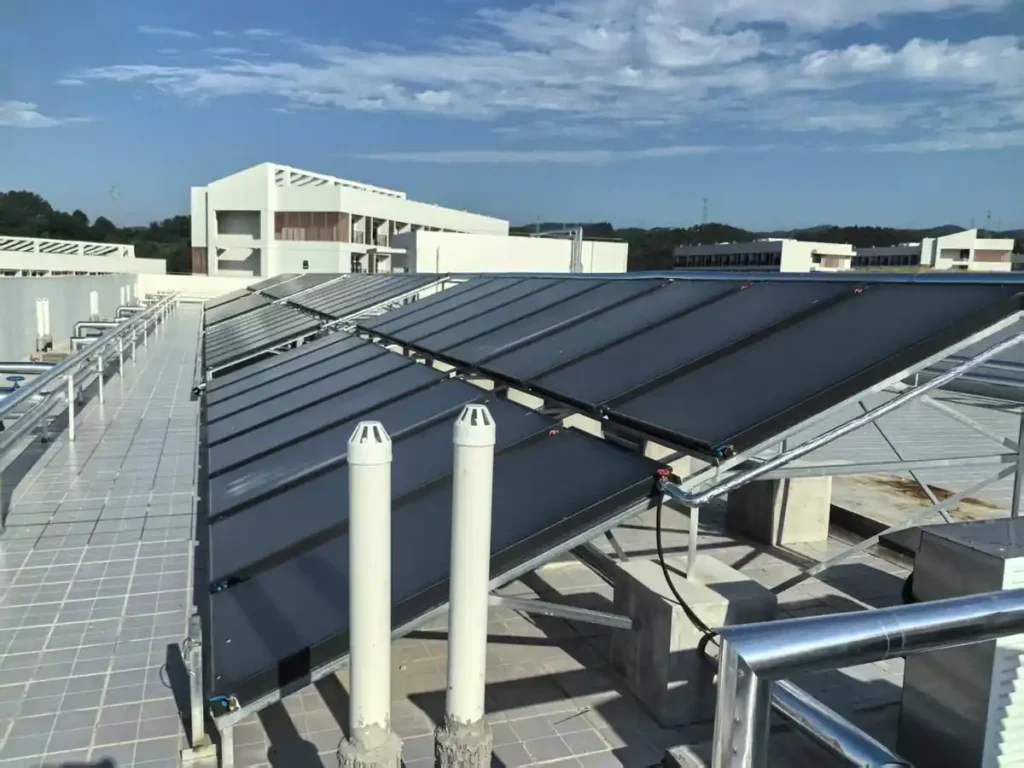
| Hotel, hospital, or large dormitory | A centralized split solar system is usually the first option to evaluate | Hourly load, central storage, recirculation, hygiene controls, redundancy, and BMS integration |
| Commercial or industrial preheating | A small integrated heater is rarely the main project solution | Process temperature, continuous load, collector array, heat exchanger, and central storage |
When a project uses several tonnes of hot water per day, includes a central recirculation loop, or requires unified energy metering, simply multiplying small roof-mounted packages increases roof loads, valves, connections, and maintenance points. Compare the life-cycle cost of modular integrated units with a flat-plate collector array, central storage, and pump station.
Step 2: Calculate the Daily Load from the Hourly Hot-Water Profile
Start with the hot-water draw pattern instead of total occupancy alone. Hotel showers, dormitory bathing, kitchen cleaning, and staff facilities peak at different times. Two projects with the same daily volume may require different storage and backup-heating capacities.
The theoretical energy required to heat clean water can be estimated as:
Daily hot-water load (kWh) ≈ 0.001163 × hot-water volume (L) × target storage temperature − cold-water temperature
For example, heating 200 L of water from 15°C to 55°C requires:
0.001163 × 200 × 40 = 9.3 kWh/day
Add tank, piping, distribution, recirculation, and draw-off losses separately. These losses can be material in commercial and centralized systems.
How Do You Convert Mixed-Water Demand to Stored Hot-Water Volume?
When users need 40°C mixed water but the tank stores water at 55°C, use an energy balance:
Required 55°C hot-water volume = 40°C draw volume × (40 − cold-water temperature) ÷ (55 − cold-water temperature)
With 15°C cold water and a demand for 300 L of mixed water at 40°C:
300 × (40 − 15) ÷ (55 − 15) = 187.5 L
This equation supports preliminary planning. Final design must also account for thermostatic mixing-valve performance, usable tank volume, stratification, minimum acceptable outlet temperature, and pipe losses.
Step 3: Size Collector Area and Storage Together
Set a Target Solar Fraction
Solar fraction is the share of the water-heating load supplied by solar energy over a defined period. A higher target usually requires more collector area and thermal storage, but excessive collector area also increases summer stagnation and overheating risk.
The U.S. Department of Energy’s Solar Hot Water System Calculator uses the local solar resource, economics, and a specified solar-load contribution to estimate system size. DOE FEMP: Solar Hot Water System Calculator
Worked Collector-Area Example
Continue with the 9.3 kWh/day water-heating load and assume:
- target solar fraction: 60%;
- design-period daily irradiation on the collector plane: 5.0 kWh/m²·day; and
- estimated net system efficiency at the relevant operating condition: 45%.
The required solar contribution is:
9.3 × 60% = 5.58 kWh/day
Estimated useful daily energy per square metre is:
5.0 × 45% = 2.25 kWh/m²·day
The estimated collector area is therefore:
5.58 ÷ 2.25 = 2.48 m²
This example explains the relationship among load, solar resource, system efficiency, and area. The 45% value is an assumption, not a universal flat-plate efficiency. Final selection should use monthly or hourly site weather data, the tested collector efficiency curve, orientation, tilt, shading, inlet-water temperature, draw profile, tank loss, and backup-control sequence.
Compare Usable Storage Volume
A nominal 200 L tank may not deliver all 200 L at the required temperature. Ask for:
- gross and usable storage volume;
- inlet and outlet temperatures used for performance evaluation;
- tank stratification behaviour;
- daily draw quantity and timing;
- insulation construction and standby heat loss;
- electric-element position and the volume it can heat; and
- collector quantity and total aperture area.
Increasing storage without increasing collector area can leave the tank below the required temperature in winter. Oversizing the collector field relative to storage and demand can increase stagnation during sunny periods with low water use.
Step 4: Choose Direct or Indirect Heat Transfer
Direct System
In a direct system, potable water enters the collector or participates directly in the solar circuit. The arrangement uses fewer components and avoids an intermediate heat-exchange temperature difference. Check:
- freezing risk;
- water hardness and scaling potential;
- chloride, salinity, and corrosion risk;
- compatibility among water, collector channels, and tank materials; and
- access for flushing and descaling.
Indirect System
An indirect system uses a separate heat-transfer fluid and transfers energy to potable water through a jacket or coil. It isolates the solar loop and can support an antifreeze solution. It also adds heat-exchange loss, expansion requirements, filling and venting procedures, and fluid-maintenance work.
The U.S. Department of Energy’s solar water-heating technical assessment distinguishes direct systems that circulate potable water through the collector from indirect thermosiphon systems that circulate antifreeze through a heat exchanger around or inside the potable-water tank. It also warns that exposed piping remains vulnerable in freezing conditions. DOE FEMP: Solar Water Heating Technology Assessment
Tank insulation alone does not protect every part of the installation. Collector channels, roof pipes, valves, and fittings may freeze first. Define the project design minimum temperature, heat-transfer-fluid type and concentration, material compatibility, replacement interval, venting method, and protection during loss of water supply.
Step 5: Verify the Pressure Vessel and Safety Components
The supplier and project designer should jointly confirm:
- tank maximum working pressure and test pressure;
- site static pressure and possible pressure surges;
- inlet pressure-reducing requirements;
- potable-water expansion control when a check valve creates a closed circuit;
- temperature-and-pressure relief-valve rating, setpoint, and discharge capacity;
- a safe and visible relief discharge route;
- vacuum-breaking, air-venting, and drainage requirements;
- tank lining or stainless-steel grade, weld construction, protective coating, and anode;
- connection sizes, thread standards, and local plumbing compatibility.
Keep working pressure, test pressure, and relief-valve set pressure as separate items in the purchase specification. Each serves a different function.
Step 6: Manage Stagnation, Overheating, and Low-Use Periods
The collector may continue absorbing solar energy after the tank reaches its maximum permitted temperature, during a water outage, or while a building is unoccupied. This no-load condition is known as stagnation. It can expose the collector, seals, insulation, valves, and heat-transfer fluid to high temperature and pressure.
Research from the IEA Solar Heating and Cooling Programme identifies incorrect mounting, poorly positioned vacuum breakers, missing insulation, and corrosion as important thermosiphon failure mechanisms. The reports explain that installation faults can lead to stagnation, overheating, overpressure, unintended fluid loss, or leakage. IEA SHC Task 69: Thermosiphon System Publications
Define:
- the collector’s standard stagnation temperature;
- maximum permitted tank temperature and pressure;
- pressure relief, expansion capacity, and high-temperature component ratings;
- procedures for holidays, water outages, and long unoccupied periods;
- any manufacturer-approved shading, heat dissipation, temperature-limiting, or other protection; and
- thermal stability and replacement intervals for antifreeze fluid.
Removing a relief valve, deliberately wasting water, or covering a collector with unapproved material is not a normal overheating-control strategy.
Step 7: Add Auxiliary Heating and Define the Control Sequence
Solar output changes with weather and demand. A reliable hot-water service normally needs an auxiliary heat source. Compact pressurized systems may use an electric element inside the tank. The solar tank can also preheat water before a separate electric water heater or heat-pump water heater.
For an internal electric element, verify:
- heating capacity, voltage, phase, and maximum current;
- thermostat, independent overtemperature protection, residual-current protection, and earthing;
- the actual storage volume heated by the element;
- start time and temperature setpoint;
- solar-priority logic before auxiliary heating starts; and
- safe electrical isolation and tank drainage for maintenance.
The auxiliary heater should be scheduled around the required service time. For example, the system can assess available tank temperature before a morning peak and supply only the missing heat. Holding the tank at its maximum temperature all day can reduce the useful solar contribution and increase losses.
Step 8: Check Roof Structure, Mounting, and Thermosiphon Geometry
The water in a 300 L tank weighs approximately 300 kg before adding the tank, collector, frame, pipes, fittings, and installation loads. A structural engineer should review full operating weight, point loads, wind, snow, roof-edge distance, anchors, and waterproofing details.
The installation review should include:
- roof construction and allowable loads;
- flat or pitched mounting surface;
- collector orientation, tilt, and year-round shading;
- frame materials for coastal, humid, or industrial environments;
- anchoring, waterproofing, and wind-uplift design;
- lifting route and safe roof handling;
- tank elevation above the collector;
- continuously rising or falling thermosiphon pipes without air traps or unintended low points;
- outdoor insulation with UV and weather protection; and
- service access to the relief valve, anode, electric element, and connections.
The DOE thermosiphon guidance specifically calls for roof mounting that avoids water intrusion and structural damage and follows local building and plumbing codes. DOE Building Science Education: Thermosiphon Solar Water Heaters
Step 9: Include Potable-Water Hygiene and Scald Protection
Solar tank temperature changes with weather and water use. The design must manage both stored-water hygiene and scald risk. Centralized systems in apartment buildings, hotels, schools, senior living, and healthcare facilities may also require a formal building water-management program.
The CDC identifies water age, temperature, sediment, biofilm, and disinfectant residual as factors affecting Legionella growth in building water systems. It recommends placing thermostatic mixing valves close to fixtures so that the system can maintain its required hot-water temperature while reducing scald risk at the point of use. CDC: Controlling Legionella in Potable Water Systems
Storage temperature, periodic disinfection, recirculation temperature, mixed outlet temperature, and monitoring frequency must follow local regulations and the project’s water-management plan. A single universal temperature cannot replace an assessment of occupant vulnerability, pipe length, water age, and anti-scald measures.
Step 10: Compare Suppliers with Verifiable Performance Data
Collector-Level Documents
Request:
- gross, aperture, and absorber area;
- optical or zero-loss efficiency and first- and second-order heat-loss coefficients;
- incidence-angle modifier data;
- test flow rate and heat-transfer fluid;
- working pressure, test pressure, and standard stagnation temperature;
- dimensions, weight, and connection details;
- wind, snow, hail, or mechanical-load information; and
- ISO 9806, Solar Keymark, or other target-market test and certification scope.
Whole-System Documents
A collector certificate does not establish the output of the complete solar water heater. Tank losses, heat exchangers, controls, piping, valves, and auxiliary heating all affect delivered performance.
ICC-SRCC makes a clear distinction between OG-100 collector certification and OG-300 complete solar water-heating system certification. OG-100 evaluates the collector component. OG-300 evaluates a system assembled from the collector, tank, pumps where applicable, heat exchangers, controls, piping, and valves. ICC-SRCC: Difference Between OG-100 and OG-300
Certification requirements differ by country and tender. Check the certificate holder, manufacturer, model, construction, electrical version, expiration status, and market scope. A certificate for a similar model or one component should not be presented as proof for the complete ordered system.
A Practical Project Selection Process
- Obtain at least one day, and preferably one week, of hourly hot-water demand.
- Confirm cold-water, storage, point-of-use, and recirculation temperatures.
- Calculate daily energy demand and peak auxiliary recovery.
- Obtain monthly or hourly solar radiation and ambient-temperature data for the site.
- Set the target solar fraction and auxiliary-heating boundary.
- Model collector area and storage using the tested performance curve.
- Check summer stagnation, winter shortfall, freeze risk, and water quality.
- Verify mains pressure, hydraulic safety, and potable-water hygiene.
- Complete the roof structure, wind, snow, anchoring, waterproofing, and service review.
- Agree on the model, bill of materials, drawings, acceptance method, and warranty scope.
How Can a CASSKY Pressurized Flat-Plate Solar Water Heater Support the Project?
The CASSKY Flat Plate Pressurized Solar Water Heater combines a flat-plate collector, insulated pressurized tank, and roof frame in a compact thermosiphon package. It is intended for residential developments and light-duty projects that need pressurized hot-water delivery from a coordinated roof-mounted product.
The current CASSKY planning range includes:
| Item | Current configuration range and status |
|---|---|
| System type | Integrated roof-mounted pressurized thermosiphon system |
| Tank capacity | 150–300 L current selection range; confirm the available model |
| Collector quantity | Commonly one or two panels; confirm by model |
| Circulation | Natural thermosiphon circulation |
| Inner tank | Stainless-steel or enamel options subject to model confirmation |
| Heat exchange | Direct, jacket, or coil options subject to model confirmation |
| Electric backup | Optional; confirm capacity, voltage, and protection |
| Mounting | Flat-roof or pitched-roof arrangement subject to project review |
| OEM | Branding, color, electrical options, packaging, and documents can be discussed |
These figures support initial screening. Final procurement should use an approved model table and confirmed usable storage volume, collector aperture area, working and test pressure, full operating weight, materials, water-quality limits, safety components, certification, and warranty documents.
CASSKY can review the destination country, climate, hot-water demand, mains pressure, water quality, roof type, and auxiliary-heating plan before confirming a package. Distributors and OEM buyers can also develop an approval schedule covering the tank, casing, collector, frame, electric heater, valves, labels, manuals, packaging, and spare parts.
Project RFQ and Supplier Comparison Table
| RFQ section | Information to provide or request |
|---|---|
| Site conditions | Country, city, elevation, minimum and maximum temperature, solar resource, wind, snow, and corrosion exposure |
| Hot-water load | Application, occupancy, hourly draw, cold-water temperature, storage temperature, outlet temperature, and recirculation |
| Solar target | Target solar fraction, operating season, cloudy-period service requirement, and auxiliary source |
| System configuration | Direct/indirect, thermosiphon arrangement, tank capacity, usable volume, collector quantity, and aperture area |
| Performance | Collector efficiency parameters, estimated annual system output, assumptions, and weather file |
| Pressure and safety | Working/test pressure, reducing valve, check valve, expansion, relief valve, drainage, and vacuum protection |
| Water and materials | Tank, absorber, channels, heat exchanger, anode, and permitted hardness, chloride, salinity, and pH |
| Freeze and stagnation | Minimum temperature, heat-transfer fluid, stagnation temperature, expansion, temperature limiting, and shutdown plan |
| Electric backup | Capacity, supply, thermostat, overtemperature protection, residual-current protection, sequence, and wiring diagram |
| Roof installation | Full weight, point load, frame, tilt, wind/snow load, anchoring, waterproofing, and service access |
| Documents and compliance | Datasheets, manual, hydraulic drawing, bill of materials, test reports, and target-market certificates |
| Commercial and service | Price, MOQ, lead time, packaging, freight, warranty start, spare parts, and claim responsibility |
| OEM | Logo, color, nameplate, language, packaging, manuals, sample approval, and change control |
What Should Be Checked During Commissioning?
At minimum, record and verify:
- model, capacity, collector quantity, nameplate, and supply list;
- frame anchoring, roof waterproofing, orientation, tilt, and shading;
- structural condition and connection stress after filling;
- correct cold-water, hot-water, solar-circuit, and relief connections;
- pressure test, leak inspection, and relief discharge;
- thermosiphon pipe slope, air removal, and insulation integrity;
- electric-backup earthing, residual-current protection, thermostat, and overtemperature protection;
- thermostatic mixing and point-of-use scald protection;
- tank temperature rise under recorded sunny conditions; and
- user training, water-outage and holiday procedures, maintenance, and warranty documents.
One day’s water temperature does not prove annual output. The commissioning record should include solar irradiance, ambient temperature, cold-water temperature, initial tank temperature, draw volume, and test duration.
Common Procurement Risks
- Selecting only by occupancy or nominal tank volume without calculating load and collector area.
- Receiving an absorber-coating value without a complete collector efficiency curve and test standard.
- Accepting “pressurized” without working pressure, test pressure, and relief-valve data.
- Accepting “freeze resistant” without the loop type, heat-transfer fluid, and design minimum temperature.
- Ignoring full-tank roof load, wind uplift, and waterproofing details.
- Oversizing collector area without a summer stagnation and long-vacancy plan.
- Receiving a collector certificate without a whole-system model and certification scope.
- Approving an OEM offer without locking materials, components, documents, certification, and change responsibility.
Frequently Asked Questions
Can a pressurized flat-plate solar water heater connect directly to mains water?
A model designed and rated for pressurized service can support mains-pressure delivery. The project still needs to verify static and surge pressure, tank working pressure, pressure reduction, check valves, thermal expansion, relief protection, and local plumbing codes.
How many people can use a 200 L system?
Occupancy supports early screening. Accurate selection also requires daily draw, draw timing, inlet temperature, storage temperature, solar radiation, collector area, and backup capacity. Four people with different shower flow rates and habits can create very different loads.
Why does a thermosiphon system work without a pump?
Heated fluid becomes less dense and rises, while cooler fluid falls back into the collector. The tank must sit above the collector, and the connections and pipe slopes must follow the approved installation drawing.
Can a flat-plate solar water heater operate in winter?
It depends on the minimum temperature, direct or indirect circuit, heat-transfer fluid, exposed piping, and approved freeze-protection design. The product name alone does not establish suitability for a freezing climate.
Will the system provide hot water during cloudy weather?
Solar output falls during cloudy periods. An electric element, heat pump, or another auxiliary source supplies the shortfall. Define the required service level over consecutive low-solar days and verify backup recovery time.
Does a flat-plate collector certificate cover the complete water heater?
No. Collector certification evaluates the heat-collection component. Whole-system certification also considers the tank, heat exchanger, controls, valves, piping, and auxiliary heater. Check whether the certificate covers the component or the complete ordered system.
Can a large hotel install many integrated solar water heaters?
A modular layout can be evaluated, but roof loading, number of service points, hydraulic balancing, recirculation, hygiene control, and total cost must be compared with a centralized split system. Large centralized loads often justify a collector array with central storage.
Send These Inputs for a Comparable CASSKY Proposal
Send CASSKY the project country and city, hourly hot-water demand, cold and target temperatures, mains pressure, water quality, roof drawings, orientation and shading, minimum temperature, wind and snow conditions, auxiliary heat source, electrical supply, required certifications, quantity, and OEM requirements.
Ask the selection response to include the specific model, usable storage volume, collector aperture area, estimated solar output and assumptions, pressure and safety components, full operating weight, direct or indirect circuit, freeze and stagnation strategy, electric-backup data, installation drawing, supply boundary, and warranty scope.
Send your pressurized flat-plate solar water heater project conditions to CASSKY
References
- ISO 9806:2025: Solar Thermal Collector Test Methods
- U.S. Department of Energy: Thermosiphon Solar Water Heaters
- U.S. Department of Energy FEMP: Solar Hot Water System Calculator
- U.S. Department of Energy FEMP: Solar Water Heating Technology Assessment
- ICC-SRCC: Difference Between OG-100 and OG-300
- ICC-SRCC: OG-300 Solar Water Heating System Certification
- CDC: Controlling Legionella in Potable Water Systems
- IEA SHC Task 69: Thermosiphon Solar Water Heating Publications
- CASSKY: Flat Plate Pressurized Solar Water Heater