
For load calculations, source-loop assessment, hydraulic design and equipment selection, begin with CASSKY’s Water and Ground Source Heat Pump System Design Guide.
This article addresses a different decision: how should distributors, EPC contractors, consultants and project buyers evaluate water source heat pump manufacturers before approving a supplier?
A product catalogue can establish a preliminary range. However, it does not prove that the supplier controls production, tests the offered model, holds applicable certification, meets the required schedule or can support installed units after shipment.
Therefore, supplier approval should examine six evidence areas:
- Factory and production capability
- Performance and safety testing
- Exact-model certification
- Manufacturing quality control
- MOQ and delivery capability
- Spare-parts and after-sales service
The objective is not to identify the supplier with the most certificates or the lowest unit price. Instead, it is to determine whether the supplier can repeatedly deliver the approved product configuration and support it throughout the project.
What Project Buyers Need to Verify
Different buyers face different risks.
| Buyer | Primary concern | Evidence needed |
|---|---|---|
| Distributor or importer | Can the supplier deliver a repeatable product line for the destination market? | Product range, compliance scope, MOQ, lead time, private-label controls and spare-parts plan |
| EPC contractor | Will the equipment integrate with the source loop, building water system and controls? | Exact-model performance data, hydraulic information, wiring, BMS points and commissioning support |
| Consulting engineer | Are published ratings applicable to the project conditions? | Test standard, rating conditions, performance maps and measurement boundary |
| Project developer | Can the supplier maintain delivery, quality and lifecycle support? | Factory capacity, quality plan, schedule, warranty and service process |
| Procurement team | Are quotations commercially and technically comparable? | Defined supply scope, Incoterm, production schedule, inspection plan and document register |
| OEM brand owner | Can product changes be controlled across repeated orders? | Approved BOM, drawings, firmware, labelling, packaging and engineering change procedure |
In addition, buyers should distinguish a manufacturer from a trading company that does not control design, production or serial-number records. A trading company can still provide value. However, its role, authority and access to the original factory must be clear.
CASSKY’s Public Manufacturer Positioning
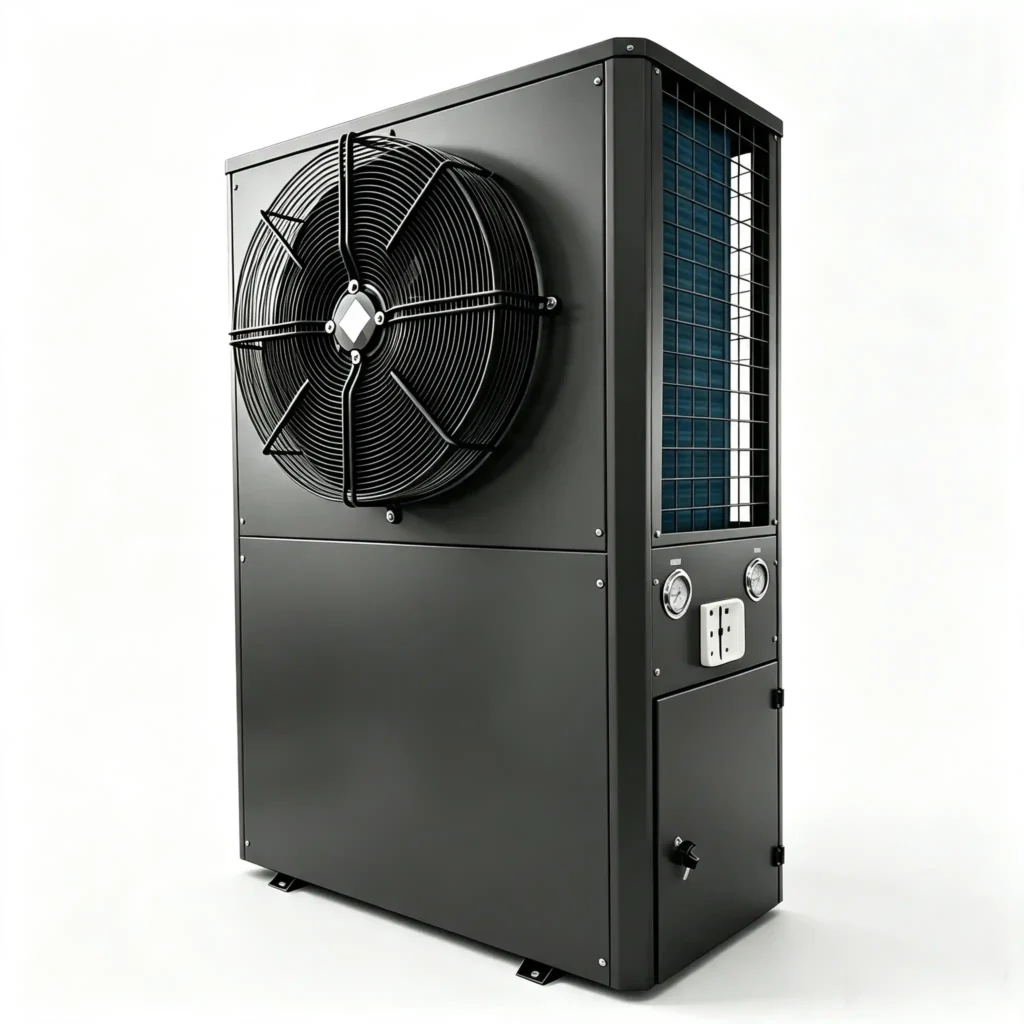
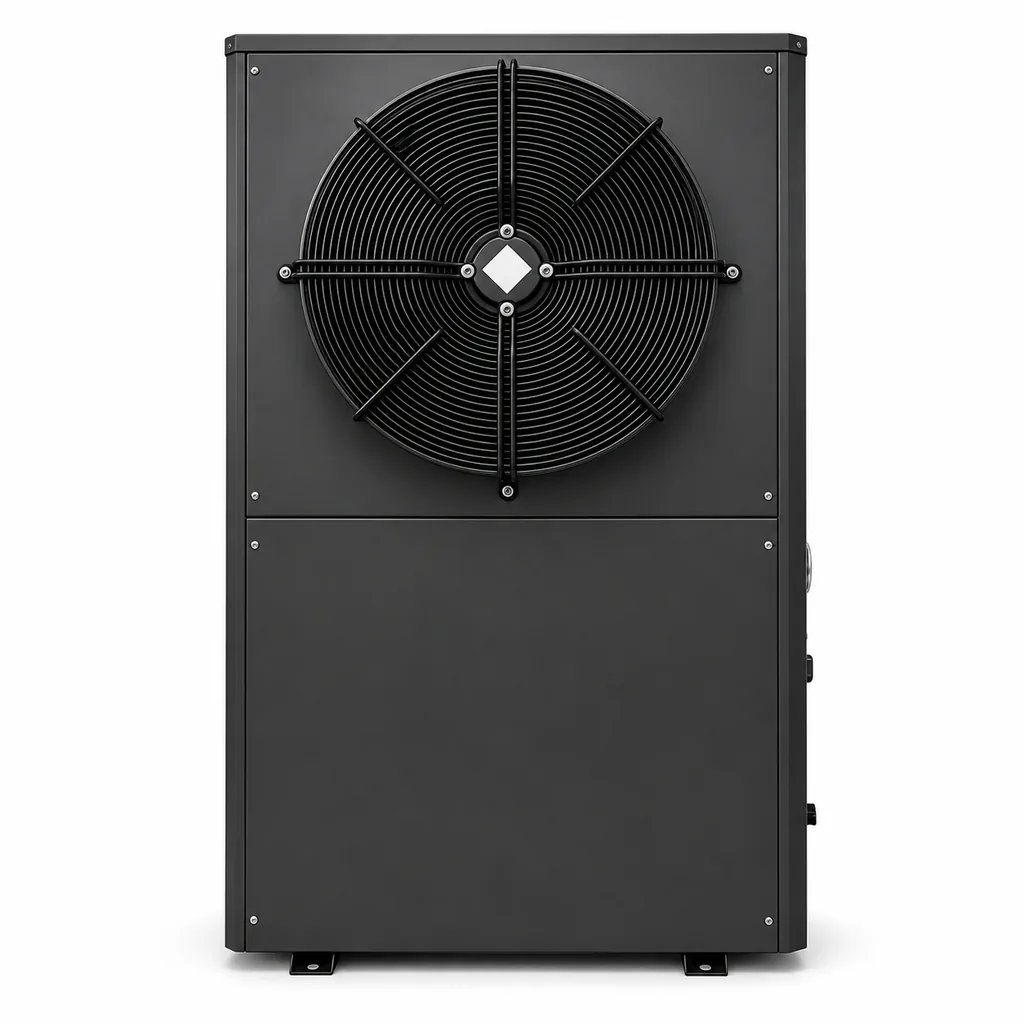
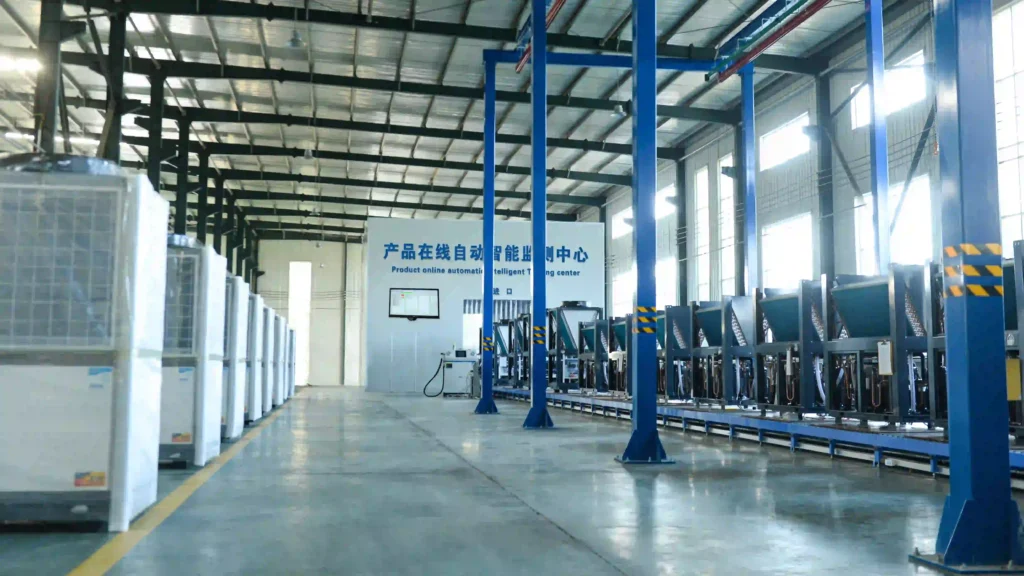
CASSKY’s public company information states that the business was founded in 1996 and combines product development, manufacturing, quality control and technical support. Its website shows a manufacturing base, heat-pump assembly line, automated production equipment and customer factory visits. It also lists water and ground source heat pumps among its manufactured product categories. CASSKY company and factory overview
The public CASSKY All-in-One Water / Ground Source Heat Pump page identifies an indoor water-to-water platform for heating, cooling and domestic hot water. Its preliminary series data include:
| Parameter | Public series reference | Evidence boundary |
|---|---|---|
| Heating capacity | 6–30 kW | Series range; exact model required |
| Cooling capacity | 5–26 kW | Series range; exact model required |
| Maximum heating outlet water | Up to 60°C | Model and operating-condition dependent |
| Minimum cooling outlet water | Down to 7°C | Model and operating-condition dependent |
| Reference heating COP | Up to 4.8 at B0/W35 | Reference test point, not seasonal project performance |
| Reference cooling EER | Up to 5.2 at W30/W7 | Reference test point, not every model or condition |
| Source side | Ground loop or qualified water loop | Source design remains project-specific |
| Power supply | 220–240 V single phase or 380–415 V three phase | Depends on model |
| Communication | RS485/Modbus RTU options | Exact controller and point list require confirmation |
These public facts support initial supplier screening. Nevertheless, they do not establish a fixed MOQ, monthly capacity, lead time, exact-model certificate, laboratory accreditation, warranty term, spare-parts availability or after-sales SLA.
Those items must be requested and made part of the quotation or contract.
First Confirm Product-Family Fit
Before auditing the factory, confirm that the supplier’s product architecture matches the project.
Water source heat pumps are not one uniform category. The required product may be:
- Water-to-air
- Brine-to-air
- Water-to-water
- Brine-to-water
- Water-loop heat pump
- Groundwater heat pump
- Closed-loop ground source heat pump
- Heating-only, cooling-only or reversible
- Fixed-speed or inverter-driven
- Single-phase or three-phase
- Standalone or multi-unit staged
A factory experienced with small water-to-air units does not automatically have the design, testing or controls capability required for a central water-to-water plant.
Likewise, a unit rated at one source-water temperature may not be suitable across every water-loop or ground-loop condition. ISO 13256-1:2021 specifically notes that equipment rated for one liquid-temperature range may not suit all ranges covered by the standard.
Therefore, send the supplier the project conditions before evaluating price or production readiness.
Product-Fit Inputs for Supplier Review
| Input | Required project information | If unavailable |
|---|---|---|
| Application | Space heating, cooling, DHW or combined duty | Buyer to confirm |
| Heat-pump type | Water-to-air or water-to-water | Engineer to confirm |
| Source type | Ground loop, groundwater or engineered water loop | Buyer to confirm |
| Source entering temperature | Minimum, normal and maximum | To be measured or calculated |
| Source fluid | Water or defined antifreeze mixture | Designer to confirm |
| Source flow | Design and allowable range | Engineer to calculate |
| Load-side temperatures | Entering and leaving temperatures in each mode | Designer to confirm |
| Heating and cooling loads | Peak loads at stated design conditions | Engineer to calculate |
| Domestic hot water | Daily demand, peak demand and storage arrangement | Buyer to confirm |
| Electrical supply | Voltage, phase and frequency | Site data required |
| Installation location | Indoor conditions, drainage and service clearances | Site data required |
| Controls | Local controller, remote access and BMS protocol | Buyer to confirm |
| Quantity | Sample, pilot, project batch and annual forecast | Buyer to confirm |
| Destination market | Country and applicable conformity requirements | Buyer to confirm |
| Project schedule | Required approval, shipment and commissioning dates | Buyer to confirm |
Verify the Legal Manufacturer and Production Site

A supplier should identify the legal entity responsible for:
- Product design
- Manufacturing
- Export sales
- Certificate ownership
- Warranty obligations
- Technical support
- Spare-parts supply
These entities may be different. If so, the relationship and responsibilities should be documented.
Next, verify the production-site address. A company registration or office address does not prove that the supplier controls the factory shown in marketing photographs.
Useful evidence includes:
- Factory business licence
- Production-site address
- Organisation chart
- Production-process map
- Equipment list
- Recent factory video with identifiable production areas
- Live remote factory audit
- On-site buyer audit
- Sample serial-number records
- Calibration register
- Approved supplier list
- Nonconformance and corrective-action procedure
- Finished-goods and spare-parts storage areas
Aerial photographs and assembly-line images support site identification. However, they do not prove production volume, model-specific experience or process control.
Audit Real Production Capacity
A statement such as “10,000 units per year” is incomplete unless the buyer knows:
- Which product families are included
- Whether the figure is installed capacity or actual output
- Number of shifts
- Working days
- Line changeover time
- Bottleneck process
- Test-station capacity
- Seasonal workload
- Outsourced operations
- Component constraints
- Current committed orders
Ask the supplier to calculate capacity for the relevant platform.
For example:
Monthly available capacity = units per shift × shifts per day × working days × planned utilisation
However, the result must also pass through the testing bottleneck. An assembly line that can build 40 units per day does not provide 40 finished units per day if the performance-test station can process only ten.
Therefore, request separate figures for:
- Mechanical assembly
- Refrigeration work
- Evacuation and refrigerant charging
- Electrical assembly
- End-of-line testing
- Packing and loading
All capacity values should be stated as “supplier to confirm” until supported by production records.
Separate Factory Testing from Third-Party Certification
Several evidence types are often treated as interchangeable. They are not.
| Evidence | What it establishes | What it does not establish |
|---|---|---|
| Development test | Engineering data from a prototype or selected unit | Conformity of every production unit |
| Type test | Performance or safety of the tested sample under stated conditions | Unchanged mass production or project performance |
| Third-party product certification | Conformity of listed models within the programme scope | Models, voltages or configurations outside the listing |
| Factory end-of-line test | Production checks on an individual serial-numbered unit | Full performance map or independent certification |
| ISO 9001 certificate | Quality-management-system scope at the listed organisation and site | Product performance or safety |
| Laboratory accreditation | Laboratory competence for methods included in the accreditation scope | Product certification outside that scope |
| FAT | Contract tests witnessed before shipment | Site installation quality |
| Commissioning report | Installed functions under recorded site conditions | Performance at untested seasonal conditions |
Consequently, a factory test report should never be described as a product certificate unless it is issued through an applicable certification programme.
Review Performance-Test Capability
For water-to-water and brine-to-water products, ISO 13256-2:2021 establishes performance testing and rating criteria for factory-made electrically driven heat pumps.
For water-to-air and brine-to-air products, the relevant international performance standard is ISO 13256-1:2021.
A water-to-water test facility should be able to control and measure, as applicable:
- Source entering and leaving fluid temperatures
- Load entering and leaving water temperatures
- Source-side flow
- Load-side flow
- Fluid composition
- Electrical voltage and frequency
- Compressor and total unit input power
- Heating or cooling capacity
- COP or EER
- Water-side pressure drop
- Steady-state criteria
- Data-recording interval
- Instrument uncertainty
Ask for a sample test report from a model comparable to the proposed unit. The report should identify the model, serial number, test method, fluid, temperatures, flows, voltage, capacity, input power and efficiency calculation.
A report showing only “passed” is inadequate for engineering review.
Check Calibration and Laboratory Scope
A factory can maintain a useful development laboratory without holding accredited status. However, the supplier must describe the evidence correctly.
ISO/IEC 17025:2017 provides requirements for laboratory competence and valid test results. Therefore, if a supplier claims that a laboratory is accredited:
- Request the accreditation certificate
- Verify the laboratory name and address
- Check the accreditation body
- Review the current validity
- Read the technical scope
- Confirm that the required heat-pump test method is included
- Check whether the tested temperature and capacity range is covered
An ISO/IEC 17025 certificate without a relevant technical scope does not validate the heat-pump test.
For a non-accredited factory laboratory, request:
- Instrument list
- Calibration certificates
- Calibration due dates
- Measurement uncertainty
- Test method
- Staff competence records
- Correlation data against an independent laboratory
This evidence can support engineering confidence. Nevertheless, it remains different from accredited third-party testing.
Verify Certification by Exact Model
Certification should be checked against the offered product, not the manufacturer’s general brand name.
The verification record should include:
- Certificate holder
- Manufacturing site
- Exact model number
- Model family or covered series
- Voltage and frequency
- Refrigerant
- Controller or critical configuration
- Applicable standard and edition
- Certification-body name
- Issue and expiry dates
- Current status
- Public directory record, where available
The AHRI Directory of Certified Product Performance allows buyers to search certified product information by manufacturer, model and rating.
AHRI’s water-source heat-pump programme covers defined production models and verifies ratings such as heating capacity, cooling capacity, COP and EER. Its public programme page currently references the 1998 editions of ISO 13256-1 and ISO 13256-2, while ISO has published 2021 editions. Therefore, buyers must check the edition required by the certification programme, tender and destination market instead of assuming that every organisation uses the latest ISO edition. AHRI WSHP programme scope
Keep Performance and Safety Certification Separate
ISO 13256 addresses performance testing. It is not an electrical-safety certification.
Where applicable to the product and market, IEC 60335-2-40:2024 with Amendment 1:2026 addresses safety requirements for electric heat pumps, air conditioners and dehumidifiers within its scope.
However, citing an IEC standard does not prove that a product is certified to it. Request the certificate or report, identify the certification body, and confirm that the exact model and market variant are covered.
Furthermore, local requirements may include:
- Electrical-safety certification
- Electromagnetic-compatibility testing
- Refrigerant safety
- Pressure-equipment requirements
- Energy-labelling requirements
- Radio or telecommunications approval
- Building and fire requirements
- Drinking-water requirements for DHW circuits
The destination-market compliance matrix should be completed before the production configuration is frozen.
Verify the Quality-Management Certificate Correctly
As of 2026, ISO has published ISO 9001:2026, replacing the 2015 edition, with a transition period for existing certified organisations. Therefore, buyers should verify the certificate’s edition, scope, site, certification body, accreditation and transition status. ISO 9001:2026 information
ISO also makes an important distinction: ISO 9001 applies to the organisation’s quality management system. It does not certify the heat pump itself.
When a supplier claims ISO 9001 certification:
- Obtain the complete certificate
- Match the legal company name
- Match the manufacturing address
- Check the activity scope
- Check the expiry and suspension status
- Verify the issuing certification body
- Search the record in IAF CertSearch where available
A certificate covering “sales of HVAC products” does not necessarily cover design and manufacture at the factory under review.
Define the Production Quality Plan
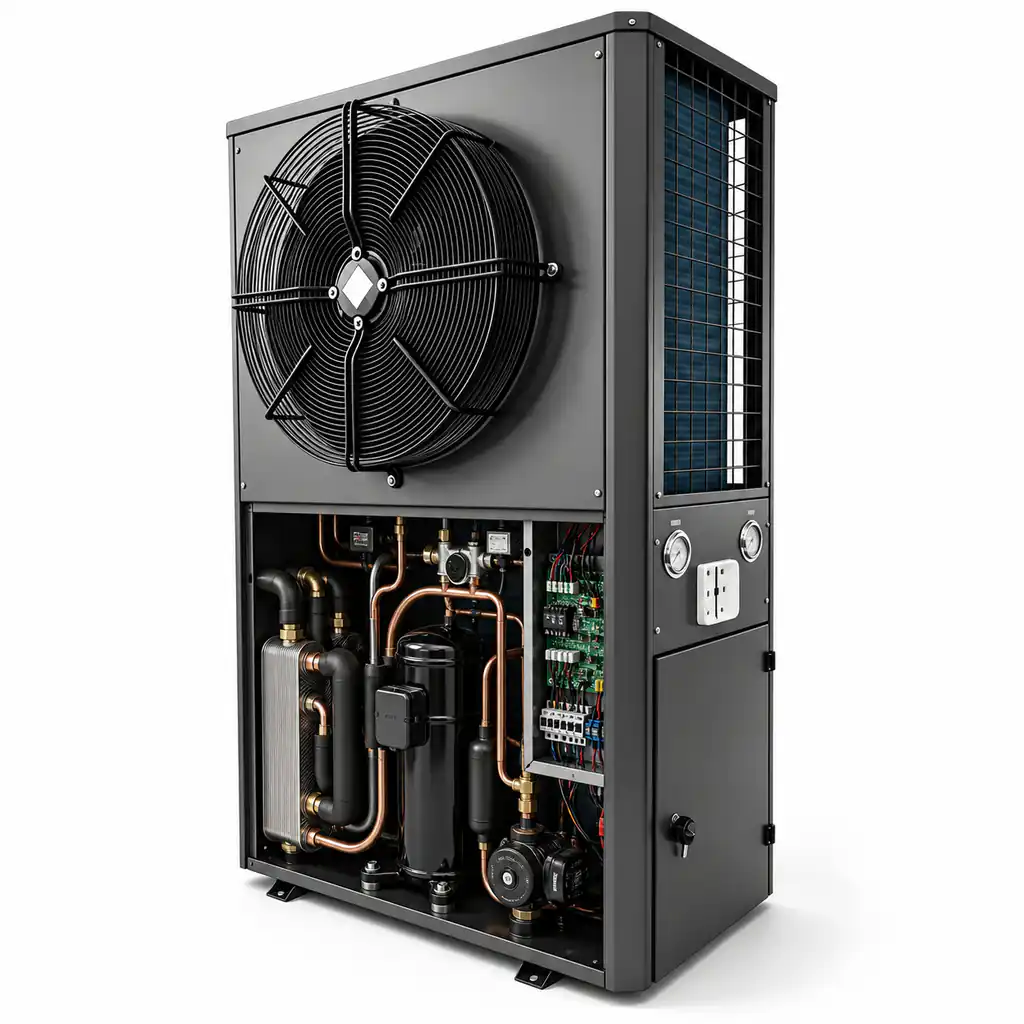
A repeatable product requires more than final inspection.
Ask the supplier for an inspection and test plan covering the following stages.
Incoming material control
Require controls for:
- Compressor identity and specification
- Heat-exchanger model and material
- Circulation pump
- Inverter and controller
- Sensors
- Valves and flow protection
- Electrical protection devices
- Copper tubing
- Refrigerant
- Insulation and cabinet parts
The approved BOM should identify critical suppliers and permitted alternatives.
Refrigeration-process control
The factory should define procedures and acceptance limits for:
- Brazing
- Joint inspection
- Pressure testing
- Leak detection
- Evacuation
- Moisture control
- Refrigerant charging
- Charge verification
- Refrigerant identification
The audit should examine actual records, not only written procedures.
Water-circuit control
Verify procedures for:
- Heat-exchanger pressure testing
- Internal piping inspection
- Pump and valve installation
- Water-side leak testing
- Flow-switch operation
- Sensor position
- Insulation and condensation control
- Drainage where applicable
Electrical and control inspection
The production record should cover:
- Component identity
- Cable routing
- Terminal torque
- Earthing continuity
- Insulation or dielectric tests where applicable
- Supply voltage and phase
- Controller version
- Input and output checks
- Protection and alarm functions
- Communication interface
End-of-line testing
Define whether each unit receives:
- Visual inspection
- Leak test
- Electrical-safety check
- Controller and display check
- Pump and valve check
- Heating operation
- Cooling operation
- Sensor plausibility check
- Alarm simulation
- Communication test
- Serial-numbered test record
A brief operational run is not the same as a full ISO 13256 performance test. That distinction should appear in the quality plan.
Require Serial and BOM Traceability
Each delivered unit should be traceable to:
- Model
- Serial number
- Production date
- Approved BOM revision
- Refrigerant and charge
- Compressor
- Controller and firmware
- Inverter
- Test result
- Inspector
- Packaging record
- Shipment
For OEM orders, the buyer should also approve:
- Brand and logo files
- Nameplate
- Rating data
- Model-number logic
- Controller language
- Manual revision
- Wiring diagram
- Packaging
- QR codes
- Spare-parts labels
If a compressor, heat exchanger, controller or refrigerant changes, the supplier should follow an engineering change process. The buyer should define which changes require notice and which require written approval or retesting.
Evaluate MOQ by Configuration
There is no responsible way to publish one universal CASSKY MOQ for every water source heat pump project. MOQ depends on the model, voltage, branding and engineering scope.
Use the following structure in the RFQ:
| Order type | Main MOQ driver | Required supplier response |
|---|---|---|
| Standard model, standard brand | Existing production and material batch | MOQ and sample availability to be confirmed |
| Standard model with private label | Labels, nameplates, packaging and manuals | MOQ by customization item to be confirmed |
| Controller-language change | Software work and validation | Engineering charge, MOQ and approval time to be confirmed |
| Different voltage or frequency | Components, testing and certification scope | Technical feasibility and MOQ to be confirmed |
| Cabinet or hydraulic modification | Tooling, drawings, BOM and retesting | Development MOQ and non-recurring cost to be confirmed |
| New refrigerant configuration | Refrigeration design, safety review and compliance | Separate engineering approval required |
| Pilot project | Sample build and additional support | Pilot quantity and commercial conditions to be confirmed |
| Annual distributor programme | Forecast, call-off batches and stock commitment | Annual MOQ and batch MOQ to be negotiated |
A low MOQ is not automatically favourable. If the order is too small to use controlled repeat-production processes, the buyer may receive a one-off configuration with weak spare-parts continuity.
Audit Lead Time as a Schedule
“Lead time: 30 days” is incomplete unless the starting and ending events are defined.
The agreed lead time should state whether it begins after:
- Deposit payment
- Signed contract
- Technical sheet approval
- OEM artwork approval
- Sample approval
- Certificate confirmation
- Final BOM release
It should also state whether it ends at:
- Production completion
- FAT acceptance
- Factory dispatch
- Port loading
- Arrival at destination
- Delivery to site
Use a milestone schedule:
| Milestone | Evidence | Responsibility |
|---|---|---|
| Technical requirements frozen | Signed technical schedule | Buyer and supplier |
| OEM files approved | Artwork and document register | Buyer |
| Long-lead components secured | Supplier confirmation or material plan | Supplier |
| Production slot reserved | Approved production schedule | Supplier |
| Assembly completed | Serial-number list | Supplier |
| Factory tests completed | Test and inspection records | Supplier |
| FAT closed | Signed FAT report and punch-list closure | Buyer and supplier |
| Export documents ready | Packing list, invoice and required shipping files | Supplier |
| Goods dispatched | Shipping record | Supplier or logistics provider |
Request separate figures for production lead time and transport time.
Moreover, require the supplier to identify schedule risks such as compressor availability, controller changes, local holidays, certification work and custom packaging.
Make the FAT Proportional to Risk
A factory acceptance test should not become a ceremonial start-up demonstration.
For a water-to-water project, an agreed FAT can include:
- Model and serial-number verification
- BOM spot check
- Nameplate and label review
- Dimensions and connection positions
- Visual workmanship
- Electrical-safety records
- Leak and pressure-test records
- Controller and firmware verification
- Heating operation at an agreed condition
- Cooling operation where applicable
- Entering and leaving temperatures
- Source and load flows
- Input power
- Calculated capacity and COP
- Low-flow protection
- High- and low-temperature protection
- Alarm logging
- Modbus or BMS communication
- Remote-monitoring function
- Packaging inspection
- Document-register review
If the factory cannot reproduce the project condition, define an alternative test point and an agreed method for interpreting the result.
A FAT verifies the product before shipment. It does not replace commissioning of the installed ground loop, water source, pumps, valves, tanks and controls.
Evaluate Spare-Parts Capability
The buyer should request a model-specific spare-parts list before the order.
Classify parts by operational impact:
| Spare-parts class | Typical examples | Buyer requirement |
|---|---|---|
| Commissioning spares | Sensors, fuses, communication accessories and selected seals | Supplier to recommend by project quantity |
| Critical electronic spares | Main PCB, display, communication board and inverter controls | Part number, firmware and compatibility to be confirmed |
| Hydraulic spares | Pump, valve actuator, flow switch and pressure sensor | Exact model and connection data required |
| Refrigeration spares | Expansion device, pressure switch and selected service components | Qualified-service requirement to be defined |
| Major components | Compressor and heat exchangers | Availability, replacement procedure and lead time to be confirmed |
| Routine service items | Filters, strainers, seals and consumable protection items | Local stock level and replacement interval to be proposed |
For every critical part, request:
- Part number
- Applicable heat-pump models
- Revision compatibility
- Unit price
- Stock location
- Normal dispatch lead time
- Emergency dispatch option
- Shelf-life or storage conditions
- Recommended distributor stock
- Obsolescence-notification period
- Substitution approval process
A statement that “spare parts are available” is not an inventory plan.
Convert After-Sales Support into an SLA
CASSKY’s support page asks service users to provide the product model, serial number, installation date, fault code, operating mode, water temperatures and supporting photographs. This is a useful diagnostic input structure. The same page states that model-specific manuals, wiring diagrams, CAD files and compliance documents can be requested after the configuration is confirmed. CASSKY support and document centre
However, a support channel is not the same as a contractual service-level agreement.
The following is an illustrative buyer requirement, not a CASSKY commitment:
| Severity | Example | Proposed initial-response target | Required next step |
|---|---|---|---|
| P1 critical | No heating, freeze risk or repeated protective shutdown | Within 4 business hours | Remote diagnostic session and containment plan |
| P2 major | Reduced capacity, one unit unavailable in a multi-unit plant | Within 1 business day | Diagnosis, parts decision and recovery plan |
| P3 routine | Noncritical alarm, monitoring or documentation issue | Within 2 business days | Written technical response |
| P4 information | Settings, drawings or spare-parts enquiry | Within 3 business days | Document or commercial response |
The supplier should accept, reject or revise each target during contract negotiation.
The final SLA should define:
- Support hours and time zone
- Working-day calendar
- Service languages
- Email, phone and messaging channels
- Escalation contacts
- Required evidence for opening a case
- Remote-access method
- Initial-response time
- Diagnostic-action time
- Spare-parts dispatch time
- On-site support availability
- Responsibility for labour and travel
- Case-record format
- Closure and recurring-failure process
Do not describe a general sales-response promise as a technical after-sales SLA.
Request Warranty Terms Before Comparing Prices
Warranty comparisons should identify:
- Start date
- Complete-unit warranty
- Compressor coverage
- Heat-exchanger coverage
- Controller and inverter coverage
- Labour coverage
- Travel coverage
- Refrigerant coverage
- International freight
- Replacement-part installation
- Commissioning requirement
- Water-quality requirements
- Flow and temperature limits
- Remote-connectivity requirements
- Maintenance records
- Exclusions
- Claim approval process
- Repeated-failure remedy
Water quality deserves particular attention. Groundwater or open-loop operation can expose heat exchangers to sediment, scaling, corrosion and biological fouling. The contract should state the permitted water conditions and any requirement for an intermediate heat exchanger.
A warranty may be valid only when those requirements are followed.
Manufacturer Evaluation Scorecard
The following scorecard is a buyer-created screening tool, not an industry certification.
| Evaluation area | Weight | Minimum evidence |
|---|---|---|
| Product and project-condition fit | 15 | Exact-model performance at relevant conditions |
| Factory identity and production control | 15 | Verifiable site, processes and model experience |
| Test capability | 15 | Test method, instruments, calibration and sample reports |
| Exact-model compliance | 15 | Current documents covering the destination-market variant |
| Quality and traceability | 10 | ITP, serial records, BOM and change control |
| MOQ and lead time | 10 | Configuration-specific commitments and milestone schedule |
| Spare parts and after-sales | 10 | Parts list, support route and negotiated SLA |
| OEM and documentation control | 5 | Approved artwork, manuals and revision control |
| Commercial and logistics scope | 5 | Defined price boundary, Incoterm and delivery responsibility |
| Total | 100 | All mandatory gates must also pass |
Suggested interpretation:
- 85–100: proceed to sample, audit or FAT if all mandatory gates pass
- 70–84: conditional approval with corrective actions
- Below 70: do not shortlist without material new evidence
A high total score cannot compensate for a failed mandatory requirement. For example, an uncertified market variant should not be approved merely because the factory and price score well.
Hypothetical Supplier Comparison
The following scenario is hypothetical.
Supplier A provides:
- A low price
- Factory photographs
- A general product catalogue
- A certificate for a different model family
- No serial-numbered test record
- No fixed BOM
- No spare-parts price list
- An undefined “fast support” promise
Supplier B provides:
- A higher price
- Exact-model performance tables
- A live factory audit
- Calibration and test records
- A controlled BOM
- A destination-market document matrix
- A milestone production schedule
- A witnessed FAT
- A model-specific spare-parts list
- A negotiated support escalation process
Supplier A may still become acceptable after closing the evidence gaps. However, its initial quotation carries greater certification, production and service risk.
The comparison also shows why supplier evaluation should not be reduced to unit price or factory appearance.
When a Factory Audit Is Not Enough
A factory audit is useful, but it cannot prove every project requirement.
Additional work remains necessary when:
- The offered model is outside the factory’s usual capacity range
- A new refrigerant is proposed
- The voltage or frequency differs from the existing product
- The private-label design changes critical components
- The product requires new destination-market certification
- Several units must operate as a staged plant
- The project uses unusual source temperatures or fluid
- An open-loop source has difficult water chemistry
- BMS integration is contract-critical
- The buyer requires guaranteed seasonal performance
In these cases, require additional engineering review, sample testing, certification or a pilot project.
Supplier Warning Signs
Pause the approval process if:
- The supplier will not identify the legal manufacturer.
- The certificate holder does not match the supplier or explained manufacturing relationship.
- The offered model is absent from the certificate scope.
- Performance data omit entering-water temperatures or flow.
- The supplier uses ISO 9001 as proof of product performance.
- A factory operational test is presented as third-party certification.
- The supplier cannot provide serial-number traceability.
- Critical components can change without buyer approval.
- MOQ changes after the technical configuration is agreed.
- Lead time starts from an undefined event.
- No spare-parts list is available.
- The warranty excludes labour, freight and installation without stating so clearly.
- After-sales support has no escalation contacts or response targets.
- The supplier promises water-source operation without reviewing water quality.
- Factory capacity is stated without considering test-station throughput.
Downloadable and Verifiable Resources
Use these primary resources during supplier evaluation:
- CASSKY 2026 Product Catalogue
- CASSKY Support and Document Centre
- ISO/IEC 17025 Free Overview
- AHRI Water-Source Heat Pump Programme Manual
- AHRI Certified Product Directory
- IAF CertSearch
- ISO 13256-1:2021 Reference Page
- ISO 13256-2:2021 Reference Page
- IEC 60335-2-40:2024 Reference Page
- ASHRAE Commissioning Resources and Standard 202-2024
The ISO, IEC and ASHRAE standards may require purchase. Exact CASSKY model datasheets, wiring diagrams, hydraulic drawings, current certificates, FAT formats, warranty terms, MOQ, lead time and spare-parts information should be described as request documents until supplied for the selected configuration.
Water Source Heat Pump Manufacturer FAQ
Does owning a factory prove that the supplier can deliver my project?
No. Factory ownership does not establish model fit, available capacity, test capability, compliance or schedule. Verify each area separately.
Is ISO 9001 a heat-pump product certificate?
No. ISO 9001 concerns the organisation’s quality management system. It does not certify a heat pump’s capacity, efficiency or safety.
Does an ISO 13256 test report prove market compliance?
Not by itself. It may provide performance evidence under stated conditions. Market compliance can also require safety, EMC, refrigerant, pressure, energy-labelling and local regulatory evidence.
Should every production unit receive a full performance test?
Not necessarily. A manufacturer may use type testing, production sampling and end-of-line functional tests. The buyer should approve the test plan, sampling rate and acceptance criteria.
How should MOQ be compared?
Compare MOQ for the same model, branding, voltage, controller, packaging and documentation scope. A standard product and a redesigned OEM configuration should not be expected to have the same MOQ.
What controls the lead time?
Lead time can depend on technical approval, long-lead components, private-label materials, certification, production slots, FAT and shipping. Define the start and end milestones contractually.
Which spare parts should a distributor stock?
Use the supplier’s model-specific recommendation and local service strategy. Prioritise low-cost parts that can stop operation, including sensors, boards, controls and selected hydraulic components.
Can remote support replace local service?
No. Remote support can assist diagnosis and settings. Refrigerant, electrical and hydraulic work still requires appropriately qualified local personnel.
Request a Manufacturer and Project Review
To evaluate CASSKY for a water or ground source heat-pump project, submit:
- Destination country
- Application and building type
- Heating and cooling loads
- Domestic hot-water demand
- Source type
- Minimum and maximum source temperatures
- Available source flow
- Water analysis or ground-loop design status
- Required load-side temperatures
- Power supply
- Required quantity
- Sample and annual forecast
- Target delivery schedule
- Required certification
- OEM branding and document scope
- FAT and inspection requirements
- Spare-parts expectations
- Proposed after-sales SLA
- Installation and commissioning responsibilities
CASSKY can then review preliminary product fit, manufacturing scope, documentation availability and commercial requirements. MOQ, production lead time, exact-model certification, warranty, spare-parts commitments and service response should be confirmed in the resulting quotation or contract.