
Buyers should not select an evacuated tube solar hot water system from tank volume and tube quantity alone. Instead, they should also evaluate the hot-water load, climate, water pressure, water chemistry, roof conditions, backup-heating strategy and local compliance requirements.
The CASSKY evacuated-tube solar water heater product page presents integrated, pressurized and indirect product configurations. This project guide covers the broader procurement decision. Therefore, it explains how an EPC, distributor or project buyer can assess technical fit, supporting evidence and delivery risk before preparing an RFQ.
CASSKY’s public product information provides preliminary configuration guidance. However, buyers must request the exact working pressure, tank material, insulation specification, collector performance, electrical configuration, certificate scope, warranty, MOQ and production schedule for the offered model.
What Buyers Need to Decide First
A suitable solar water-heating system must match both the building and the operating conditions. Consequently, the first review should answer six questions.
| Decision question | Evidence required |
|---|---|
| Can the system meet the daily hot-water load? | Draw profile, inlet temperature, delivery temperature, climate data and modeled solar contribution |
| Does the hydraulic design match the building? | Supply pressure, static head, circulation arrangement, pipe layout and system pressure rating |
| Can the system tolerate the local climate? | Minimum temperature, freeze strategy, stagnation control, wind and snow conditions |
| Do the wetted materials suit the water? | Water analysis, tank material, heat-exchanger material and supplier limits |
| Does the offered model meet the project specification? | Model-specific drawings, test reports, certificates and market documents |
| Can the buyer receive and maintain the equipment? | Packing details, spare-tube plan, replacement parts, manuals and confirmed delivery schedule |
If the project team cannot answer these questions, it should treat the quotation as preliminary.
Where Evacuated Tube Solar Hot Water Fits
Evacuated tubes reduce heat loss between the absorber and the surrounding air. As a result, they can remain useful when the ambient temperature falls below the required water temperature.
However, the evacuated tube forms only one part of the system. The tank, heat exchanger, pipework, controls, backup heater and installation conditions also determine project performance.
Suitable applications
An evacuated tube solar hot water system may suit:
- Homes, villas and residential developments
- Hotels, guesthouses and dormitories
- Worker camps and staff accommodation
- Sports facilities and changing rooms
- Restaurants, kitchens and washing facilities
- Hospitals and care facilities with suitable hygiene controls
- Industrial water preheating within the declared temperature range
- Decentralized buildings where shorter hot-water pipes reduce distribution losses
These applications usually offer regular hot-water demand. In addition, the solar system should replace a measurable amount of electricity, gas or another purchased fuel.
Applications that need additional engineering
Some projects require a pumped loop, external storage tank or hydraulic separation. For example, the following conditions usually need additional engineering:
- Freezing winter temperatures
- High mains-water pressure
- Long distances between collectors and storage
- Centralized hot-water production for several buildings
- Hard, saline or chemically aggressive water
- Highly seasonal or irregular demand
- Low summer demand combined with high summer irradiation
- Integration with boilers, heat pumps or building controls
- Strict roof-loading, wind or service-access limits
In these cases, a complete system design matters more than the number of tubes.
Conditions that can make the product unsuitable
An integrated rooftop unit may not suit the project when:
- The roof cannot support the full tank, water, frame and maintenance load.
- The proposed tank cannot handle the building’s maximum water pressure.
- The design connects a non-pressure tank directly to pressurized mains.
- The process requires a temperature outside the manufacturer’s declared range.
- The site lacks adequate solar access and has no acceptable backup source.
- Nearby structures or vegetation regularly shade the collectors.
- The water chemistry conflicts with the tank or heat-exchanger material.
- The specification requires complete-system certification, but the supplier can only document the collector.
For example, a 200-litre non-pressure thermosiphon heater may suit a low-rise building with gravity delivery. However, it cannot replace a pressure-rated hotel system simply because both products have the same tank volume.
Comparing System Architectures
The correct architecture depends on pressure, climate, building layout and maintenance requirements.
| Architecture | Conditions where it may fit | Main advantages | Important limitations |
|---|---|---|---|
| Direct thermosiphon, non-pressure | Warm climates, simple low-rise buildings and gravity-fed applications | Few moving parts; no solar-loop pump; compact package | Roof carries the tank; limited pressure capability; potable water may contact the tubes; scaling and freezing need review |
| Integrated heat-pipe pressurized | Villas and small commercial loads that require pressurized hot water | Potable water normally stays inside the tank; maintenance teams can replace individual tubes | Buyer must verify tank pressure, roof load, heat-pipe limits and backup-heater configuration |
| Integrated indirect-coil system | Pressurized supplies, cold climates or projects that require hydraulic separation | The coil can separate the potable circuit from another fluid circuit | Buyer must verify coil material, surface area, pressure drop and heat-transfer rate |
| Central pumped indirect system | Hotels, dormitories, multi-building projects and centralized plant rooms | External storage, controlled circulation and flexible backup integration | Requires more components, controls and commissioning work |
| Multiple decentralized units | Villas, cabins or separated accommodation blocks | Shorter distribution runs and possible phased installation | Creates more roof penetrations, tanks and maintenance points |
CASSKY’s public product page lists preliminary market-reference configurations from 100 to 300 litres, 10 to 30 tubes and a common Ø58 × 1800 mm tube format. It also describes non-pressure, pressurized and indirect options.
Nevertheless, these ranges do not replace a model-specific datasheet. Buyers should confirm every quoted value before approving an order.
Conceptual Pumped Indirect System
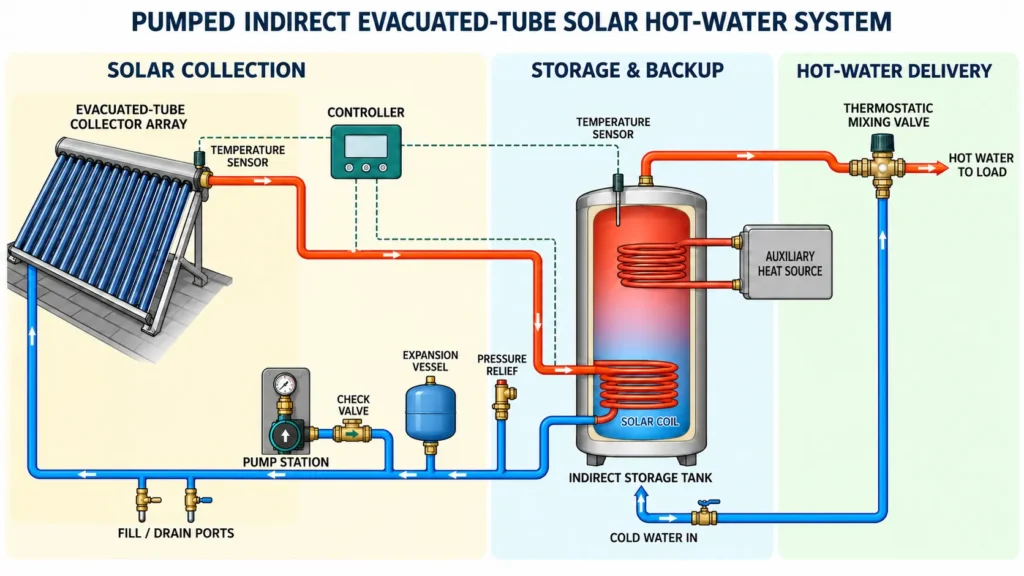
Figure 1. Conceptual pumped indirect evacuated-tube solar hot water system. The solar heat-transfer fluid remains separate from potable water. Final collector area, tank volume, pressure ratings, safety devices and controls depend on the project.
In this arrangement, a pump circulates heat-transfer fluid through the collector and the lower tank coil. Meanwhile, potable water remains in a separate circuit.
A differential controller normally starts the pump when the collector temperature rises sufficiently above the tank temperature. Then, it stops the pump when the temperature difference becomes too small.
The solar loop also needs correctly sized expansion capacity, pressure relief, air management and filling points. Moreover, the designer must select these components for the loop volume, fluid type, design pressure and stagnation temperature.
The diagram shows a design concept. It does not represent the certified configuration or output of a specific CASSKY model.
Preliminary Product Configuration Boundaries
The following values summarize the preliminary information on the CASSKY product page. Therefore, buyers should use them only for initial screening.
| Product item | Preliminary public range or option | Procurement requirement |
|---|---|---|
| Tank capacity | 100, 150, 180, 200, 240, 250 or 300 litres | Supplier to confirm for the exact model |
| Tube quantity | 10–30 tubes | Supplier to confirm |
| Common tube format | Ø58 × 1800 mm | Confirm dimensions, construction and replacement compatibility |
| Hydraulic configuration | Non-pressure, pressurized or indirect | Select according to building pressure and climate |
| Inner tank | SUS304 or market-specific option | Confirm grade, thickness, welding and water-quality limits |
| Outer casing | Stainless steel or coated steel | Confirm material and finish |
| Insulation | Approximately 50 mm PU as preliminary reference | Confirm thickness, density and declared heat loss |
| Frame | Galvanized or coated steel | Confirm material, coating and structural limits |
| Internal coil | Optional | Confirm material, area, pressure and pressure drop |
| Electric backup | Optional | Confirm voltage, rating, safety devices and certification |
| Controller and sensors | Optional | Confirm functions, sensor quantity and communications |
| Working pressure | Configuration-dependent | Do not apply one pressure rating to every configuration |
| OEM branding | Subject to order scope | Confirm MOQ, artwork, labels, packaging and charges |
Project Selection Input Table
Before requesting final sizing, the buyer should provide the following information.
| Input category | Information to provide | Why it matters |
|---|---|---|
| Project location | City, country and altitude | Determines climate and applicable requirements |
| Weather data | Irradiation, minimum and maximum temperature, wind and snow | Affects output, mounting, freezing and stagnation |
| Application | Rooms, beds, users, meals, shifts or process cycles | Establishes the source of hot-water demand |
| Daily demand | Litres per day at a stated temperature | Defines daily thermal energy |
| Draw profile | Hourly or 15-minute consumption where available | Determines storage and peak recovery |
| Cold-water temperature | Monthly or design inlet temperature | Directly affects heating energy |
| Delivery temperature | Normal setpoint and sanitation requirement | Affects collector output and backup demand |
| Water pressure | Minimum, normal and maximum pressure | Determines tank and heat-exchanger requirements |
| Water quality | Hardness, chlorides, pH and conductivity | Influences corrosion and scaling |
| Roof conditions | Area, slope, orientation, shading and structure | Determines installation feasibility |
| Plant room | Space, drainage, access and service clearance | Affects external equipment selection |
| Existing backup | Boiler, electric heater, heat pump or other source | Defines control and hydraulic integration |
| Electrical supply | Voltage, frequency, phase and available power | Supports pumps, controls and backup heaters |
| Destination market | Country, region and required program | Determines compliance documentation |
| Procurement plan | Quantity, delivery date and destination | Supports production and logistics planning |
| OEM scope | Brand, language, labels, cartons and manuals | Defines private-label requirements |
If a value remains unavailable, label it “to be measured” or “supplier to confirm.” Likewise, identify assumed values as “for sensitivity analysis only.”
Calculating the Daily Heating Load
The first calculation converts the hot-water volume into thermal energy:
Q = m × 4.186 × ΔT ÷ 3,600
Where:
- Q represents thermal energy in kWh.
- m represents water mass in kg.
- 4.186 represents the approximate specific heat capacity of water in kJ/kg·K.
- ΔT represents the temperature rise in °C.
Illustrative load calculation
The following example supports sensitivity analysis. It does not describe a completed CASSKY project.
Assume a guesthouse uses 2,000 litres of hot water per day. The cold-water design temperature reaches 15°C, while the storage target reaches 55°C.
Q = 2,000 × 4.186 × (55 − 15) ÷ 3,600
Therefore:
Q = approximately 93.0 kWh per day
If the project initially targets a 60% solar contribution, the solar system would need to provide an average of:
93.0 × 60% = 55.8 kWh per day
Collector-area sensitivity
A buyer should not divide the load by peak irradiance to determine the final collector area. Instead, the project model should include collector coefficients, pipe losses, tank losses, shading, orientation, load timing and controls.
For early sensitivity analysis only:
| Assumed useful daily solar delivery | Indicative area for 55.8 kWh/day |
|---|---|
| 2.0 kWh/m²/day | 27.9 m² |
| 2.8 kWh/m²/day | 19.9 m² |
| 3.5 kWh/m²/day | 15.9 m² |
These assumed yields do not represent product ratings. Instead, they show how the result changes when usable solar delivery changes.
For initial weather analysis, the European Commission’s free PVGIS tool provides solar-radiation and temperature datasets. However, weather data alone cannot guarantee solar thermal yield.
How to Compare Collector Performance
A single efficiency percentage cannot describe collector performance across all conditions. In particular, output changes with irradiance and with the temperature difference between the collector and ambient air.
Collector reports commonly use a relationship such as:
η = η₀ − a₁(Tm − Ta)/G − a₂(Tm − Ta)²/G
Where:
- η₀ represents the optical-efficiency term.
- a₁ and a₂ represent heat-loss coefficients.
- Tm represents mean collector-fluid temperature.
- Ta represents ambient temperature.
- G represents solar irradiance on the collector plane.
Therefore, buyers should compare products using the same reference area, test basis and operating conditions. They should not mix gross area, aperture area and absorber area.
Evidence to request
For each shortlisted collector, request:
- Exact model designation
- Overall dimensions and reference area
- Tube quantity and dimensions
- Optical and heat-loss coefficients
- Incidence-angle modifier data where applicable
- Test fluid and flow conditions
- Pressure drop at the declared flow
- Maximum operating pressure
- Stagnation temperature or related test evidence
- Permitted installation angle
- Wind, snow and mounting limits
- Freeze-protection requirements
- Complete test-report identification
For example, a strong optical-efficiency term does not guarantee high output at a high operating temperature. Heat-loss coefficients also affect the result.
Storage and Backup Heating
The collector and storage tank must work as one system. Otherwise, an oversized collector may create frequent stagnation, while an oversized tank may remain at a low temperature and increase backup-energy use.
Storage values to distinguish
Buyers should separate:
- Nominal tank volume
- Usable hot-water volume
- Dedicated solar-storage volume
- Backup-heated volume
- Heat-exchanger surface area
- Maximum continuous draw rate
- Peak short-duration draw rate
- Declared standing loss
Furthermore, projects with concentrated morning or evening demand need hourly analysis. A daily-volume figure may hide a serious peak-capacity problem.
Backup control
A boiler, electric element or heat pump can supply backup energy. However, the control sequence should preserve useful storage capacity for solar input.
For example, a backup heater that warms the whole tank before sunrise may reduce solar utilization later in the day. Therefore, many projects separate the solar-storage zone from the backup-heated zone.
Freeze and Stagnation Protection
Climate protection must cover the complete installation. Vacuum insulation around the absorber does not protect every manifold, valve or exterior pipe.
Freeze protection options
Depending on the product and climate, the designer may consider:
- A closed loop with an approved antifreeze fluid
- Drainback operation
- Controlled circulation where the climate and power supply permit it
- Heat tracing for exposed pipework
- Seasonal drainage
- A product configuration designed for the local minimum temperature
However, the supplier must approve the chosen method. The project team must also check fluid life, concentration, pumping requirements and maintenance procedures.
Stagnation and summer overproduction
Stagnation can occur when solar energy remains available but the building stops using hot water. Schools, dormitories and seasonal hotels provide common examples.
Therefore, the project may need:
- Correct collector-to-storage sizing
- A heat-rejection strategy
- Drainback operation
- Vacation control
- Approved collector-isolation procedures
- High-temperature-compatible fluid and insulation
- A documented shutdown plan
Simply covering part of the collector array does not provide a general engineering solution. Instead, the manufacturer should approve any covering method.
Water Quality and Hygiene
Water chemistry affects tanks, heat exchangers, valves and maintenance intervals. Therefore, buyers should provide an actual water analysis rather than rely on a general description such as “municipal water.”
Water data to provide
The analysis should include:
- Total hardness
- Chloride concentration
- pH
- Conductivity
- Sulphates or other locally relevant constituents
- Existing filtration or treatment
- Planned inspection and descaling procedure
Stainless-steel grade names alone do not prove water compatibility. For example, chloride concentration, temperature, fabrication quality and cleaning chemicals can all influence corrosion risk.
Hygiene and outlet temperature
Hot-water projects also need a hygiene strategy. The World Health Organization’s Legionellosis guidance identifies temperature management, maintenance and reduced stagnation as important controls.
Nevertheless, the project must follow local regulations and its water-safety plan. In addition, the designer should address scalding risk.
A thermostatic mixing valve can reduce distribution temperature where appropriate. However, the engineer must confirm its capacity, location, fail-safe behavior and maintenance access.
Testing, Certification and Compliance
Buyers should distinguish laboratory testing from certification, market compliance, factory quality control and project acceptance. Each category answers a different question.
| Evidence category | What it establishes | What it does not establish |
|---|---|---|
| Collector laboratory test | Thermal coefficients and applicable durability, reliability or safety results | Complete-system certification or annual project yield |
| Factory-made system test | Performance of a defined system configuration | Performance of a materially different collector, tank or controller |
| Product certification | Third-party conformity for the listed models and rules | Compliance of unlisted variants or the installed project |
| Market documentation | Conformity with stated destination-market requirements | Solar yield or installation quality |
| Factory quality control | Consistency of materials, assembly and inspection | Field performance after shipping and installation |
| Project commissioning | Flow, controls, temperatures, alarms and functional operation | Long-term annual output without continued monitoring |
ISO 9806 collector testing
ISO 9806:2025 specifies test methods for the durability, reliability, safety and thermal performance of fluid-heating solar collectors.
Therefore, an applicable report can support collector comparison. However, the report must cover the exact product.
ISO 9806 addresses collector-level testing. Moreover, its scope excludes arrangements where integral storage prevents separate collector-performance measurement. Consequently, an ISO 9806 report does not automatically establish complete-system performance.
ISO 9459 system performance
The ISO 9459 series covers solar domestic water-heating systems through different procedures:
- ISO 9459-1 covers an indoor rating procedure within its stated scope.
- ISO 9459-2 addresses outdoor performance characterization and annual-performance prediction for solar-only systems.
- ISO 9459-5 covers whole-system testing combined with computer simulation within its specified conditions.
Therefore, the buyer should identify the exact part, test configuration and operating conditions. A reference to “ISO 9459” without a part number provides insufficient evidence.
Solar Keymark
The Solar Keymark scheme rules distinguish collector products, factory-made systems and custom-built systems.
Consequently, buyers should check whether the certificate covers only the collector or the complete factory-made system. They should also compare the certificate model, collector variant, tank, controller and certificate holder with the quotation.
ICC-SRCC
For North American projects, ICC-SRCC separates collector and system programs. According to the ICC-SRCC program explanation, OG-100 applies to collectors, while OG-300 addresses complete solar water-heating systems.
Therefore, buyers should check the exact model in the ICC-SRCC certified product directories. An OG-100 collector listing alone does not create an OG-300 system listing.
Electrical backup components
An electric backup heater requires a separate electrical-safety review. IEC 60335-2-21:2022 covers particular safety requirements for electric storage water heaters within its stated limits.
In addition, the project must confirm national adoption, voltage, wiring, earthing, residual-current protection and ingress protection.
Model-specific documents to request
Request the following files for the offered configuration:
- Model-specific datasheet
- General arrangement drawing
- Hydraulic connection drawing
- Collector test report or report summary
- Certificate number and scope where required
- Pressure and leakage test procedure
- Tank material declaration
- Insulation specification
- Controller and electrical schematic
- Installation and operation manual
- Packing specification
- Quality inspection plan
- Spare-parts list
- Warranty terms and exclusions
CASSKY does not publish every model-specific document on the product page. Therefore, buyers should request the applicable files during the inquiry.
Factory and Pre-Shipment Checks
The purchase specification should define the inspection plan before production starts. Otherwise, the buyer and supplier may apply different acceptance criteria.
Product checks
The inspection plan may cover:
- Bill-of-material comparison with the approved configuration
- Tube quantity, dimensions and visible condition
- Tank material and thickness
- Tank pressure or leakage test
- Coil pressure or leakage test where applicable
- Controller and sensor functions
- Electric-heater rating and electrical checks
- Frame material, coating and fasteners
- Labels, serial numbers and carton marks
- Manuals, fittings and accessories
- Spare-tube and replacement-part quantities
Packing and loading checks
The buyer may also request:
- Packing-material confirmation
- Carton and pallet dimensions
- Stacking limits
- Loading photographs
- Container packing list
- Accessory count
- Spare-tube identification
- Damage-reporting procedure
However, sample inspection does not replace routine factory quality control. Therefore, the purchase order should also define the response to nonconforming goods.
Delivery and Installation Risks
Evacuated glass tubes require careful packing and site handling. Nevertheless, tube breakage risk does not automatically make the technology unsuitable.
Transport questions
The buyer should confirm:
- Whether the factory ships tubes separately or inside the unit
- How the packaging protects each tube
- Whether the factory uses pallets or crates
- How many cartons the factory can stack
- How the factory loads the container
- How many spare tubes the order includes
- Who handles transit-damage claims
- Whether replacement tubes will remain compatible
- How the buyer should store tubes before installation
Site questions
Before delivery, the project team should also check:
- Lifting access
- Roof loading
- Wind anchorage
- Roof waterproofing
- Pipe support
- Drainage
- Maintenance clearance
- Safe access for tube replacement
Furthermore, maintenance teams should be able to replace a tube without dismantling unrelated roof equipment.
Illustrative Project Case
The following scenario demonstrates the decision process. It does not represent a completed CASSKY project.
Project assumptions
- Application: 20-room guesthouse
- Daily hot-water demand: 2,000 litres
- Cold-water design temperature: 15°C
- Storage target: 55°C
- Daily heating load: approximately 93.0 kWh
- Existing backup: boiler
- Water supply: pressurized
- Climate: occasional freezing
- Plant room: available at ground level
- Roof: adequate unshaded area, subject to structural approval
Architecture decision
A non-pressure thermosiphon system conflicts with the pressurized building supply. Moreover, several full rooftop tanks would increase roof loading and complicate boiler integration.
Individual pressurized rooftop units could serve separate rooms. However, that approach would create multiple tanks, valves and maintenance points.
Therefore, a centralized pumped indirect system provides the stronger concept for further evaluation. It offers external storage, a separated freeze-protected loop and controlled boiler backup.
Nevertheless, the final decision still depends on roof structure, water chemistry, hydraulic distance, collector coefficients and lifecycle cost.
Next engineering step
At a 60% solar contribution, the conceptual solar target reaches approximately 55.8 kWh per day. However, the sensitivity calculation produces an indicative collector range from 15.9 to 27.9 m².
That range remains too wide for procurement. Therefore, the EPC should complete a project simulation using:
- Hourly or monthly weather data
- Exact collector coefficients
- Roof orientation and inclination
- Pipe lengths and insulation
- Storage configuration
- Hot-water draw profile
- Boiler control sequence
- Freeze-protection fluid
- Stagnation strategy
Afterward, the EPC can finalize the collector quantity, storage capacity and backup power.
Commissioning and Acceptance
The commissioning plan should use measurable conditions. A visual check that the pump runs does not prove correct system operation.
Mechanical acceptance
Confirm that:
- Collectors match the approved orientation and inclination.
- Frames and anchors match the structural design.
- Pipe materials and insulation match the submittal.
- Valves, drains and vents remain accessible.
- The solar and potable circuits remain separate.
- Expansion vessels have the correct pre-charge.
- Relief devices discharge to a safe location.
- Tanks, coils and pipes show no leakage.
Hydraulic acceptance
Next, confirm that:
- Circuit pressure remains within the approved range.
- The commissioning record states the antifreeze concentration.
- The installer has filled and purged the loop correctly.
- Measured pump flow matches the design requirement.
- Check valves allow the correct flow direction.
- Pressure drop does not cause unstable pump operation.
Control acceptance
Then, verify that:
- Sensors occupy the approved positions.
- Displayed temperatures agree with reference measurements.
- Pump start and stop differentials match the approved settings.
- Freeze and high-temperature functions operate correctly.
- Backup controls follow the intended priority.
- Alarms and remote signals work where specified.
Handover acceptance
Finally, record:
- Outlet temperature
- Mixing-valve setting
- Controller settings
- Fluid type and concentration
- Pump flow
- System pressure
- Equipment serial numbers
- Operator training
- Maintenance schedule
- Approved drawings and manuals
OEM and Distributor Support
The CASSKY product page describes configurable components and private-label options. In addition, the CASSKY support page provides channels for technical files and OEM discussions.
Depending on the project and order scope, buyers may request:
- Private-label branding
- Market-specific rating labels
- Carton artwork
- Manual translation
- Tank, casing or frame options
- Controller and sensor options
- Electric-backup configurations
- Installation accessories
- Spare tubes and components
- Model-specific technical files
- Packing and loading information
- Pre-shipment inspection arrangements
However, buyers should not assume MOQ, tooling charges, lead time, certificate availability, spare-parts commitments or response times. Instead, they should record these terms in the quotation and purchase agreement.
Public Technical Resources
Buyers can access the following public materials:
- CASSKY Solar Thermal Product Catalog PDF
- CASSKY evacuated-tube solar water heater product page
- CASSKY technical support and document requests
- ISO 9806:2025 collector-test scope
- ISO 9459-5 whole-system test method
- Solar Keymark scheme rules
- ICC-SRCC certified product directories
- PVGIS solar-radiation tool
- WHO Legionellosis guidance
The CASSKY catalog provides a public download. In contrast, buyers need to request exact model datasheets, drawings, test reports, certificates, inspection records and OEM files.
RFQ Checklist
A complete RFQ should include the following information.
Project conditions
- Project name, city and country
- Building or process type
- Number of users, rooms or process cycles
- Daily hot-water volume
- Hourly draw profile where available
- Cold-water temperature
- Required storage and delivery temperatures
- Minimum and maximum ambient temperatures
- Solar-resource data
- Wind, snow and altitude
- Water-pressure range
- Water analysis
System requirements
- Preferred architecture
- Required solar contribution
- Available roof area
- Roof orientation and shading
- Structural restrictions
- Plant-room space
- Existing backup-heating source
- Electrical supply
- Monitoring or BMS requirements
- Freeze-protection requirement
- Stagnation strategy
- Potable-water and hygiene requirements
Product evidence
- Exact collector and tank model
- Collector quantity and reference area
- Solar and backup storage volumes
- Tank and coil materials
- Pressure ratings
- Thermal-performance coefficients
- Applicable test reports
- Required certificates
- Connection drawings
- Controller functions
- Installation manual
- Spare-parts schedule
- Inspection plan
Commercial requirements
- Order quantity
- OEM branding
- Packaging requirements
- Delivery destination
- Target delivery date
- Incoterm
- Spare-tube quantity
- Third-party inspection
- Warranty terms
- After-sales requirements
- Document submission schedule
When information remains unknown, use “to be measured,” “for sensitivity analysis only” or “supplier to confirm.” Consequently, preliminary assumptions will not become hidden contractual requirements.
Frequently Asked Questions
Are more evacuated tubes always better?
No. Tube quantity must match tube dimensions, collector area, climate, storage and hot-water demand. Moreover, excessive collector area can increase stagnation risk.
Can a non-pressure heater connect directly to pressurized mains?
No, unless the manufacturer specifically designs and approves that arrangement. Instead, use a configuration with a suitable pressure rating or hydraulic separation.
Does ISO 9806 certify the complete system?
No. ISO 9806 addresses solar collectors within its scope. Therefore, the buyer needs separate evidence for complete-system performance or certification.
Does a vacuum tube prevent freezing?
No. The vacuum reduces absorber heat loss. However, water inside manifolds, valves and pipes can still freeze.
Can the buyer size the tank from occupant numbers?
Occupancy provides a starting point. Nevertheless, the buyer should also determine daily volume, delivery temperature and peak draw profile.
Does laboratory output guarantee project yield?
No. Laboratory data supports engineering calculations. In contrast, actual yield also depends on weather, orientation, shading, storage, controls, pipe losses, consumption and maintenance.
What should an OEM buyer verify?
The buyer should verify the exact model, bill of materials, pressure rating, electrical configuration, test scope, certificates, artwork, packing, inspection criteria, spares, lead time and warranty. Finally, the buyer should place every agreed requirement in the quotation or contract.
Request a Preliminary CASSKY Selection
For an initial evacuated tube solar hot water review, submit:
- Project country and city
- Daily hot-water volume
- Hourly draw schedule where available
- Cold-water and delivery temperatures
- Water pressure
- Water-analysis results
- Minimum winter temperature
- Roof dimensions and orientation
- Roof photographs
- Existing backup-heating source
- Required certification
- Quantity and OEM scope
- Delivery destination
CASSKY can then review the possible system architecture and identify the technical files that apply to the proposed configuration. After that, the buyer can request model-specific drawings, test information and a commercial quotation.
Final selection should rely on the confirmed product configuration, project conditions and approved technical submittal—not on a generic tube quantity or tank-volume claim.